
Willow
Willows are deciduous, woody trees and shrubs in the genus Salix, celebrated for their slender branches, elongated leaves, and preference for moist environments.
Willows are deciduous, woody trees and shrubs in the genus Salix, celebrated for their slender branches, elongated leaves, and preference for moist environments.
The willow's story begins in the temperate and cold regions of the Northern Hemisphere, where the genus Salix evolved and diversified. First formally described by Carl Linnaeus in 1753, willows now encompass over 400 recognized species and numerous hybrids. Their evolutionary lineage is complex, with notable species such as the weeping willow (Salix babylonica) tracing roots to China before spreading to Europe in the 18th century. The genus has no single breeder or institution but has been shaped by centuries of natural adaptation and human cultivation.
Willows belong to the family Salicaceae within the order Malpighiales. The genus Salix includes both tree and shrub forms, with species classified as angiosperms (flowering plants). Their botanical hierarchy is: Kingdom Plantae, Division Magnoliophyta, Class Magnoliopsida, Order Malpighiales, Family Salicaceae, Genus Salix. Some species blur the boundary between tree and shrub, reflecting the genus’s remarkable adaptability.
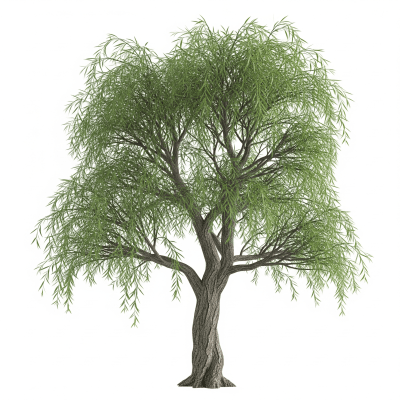
Willows typically display graceful, flexible branches that often droop or sweep downward, creating a soft, flowing silhouette. Their leaves are lance-shaped, slender, and range from 5 to 15 centimeters in length, with a fresh green hue that turns golden in autumn. Mature trees feature deeply fissured gray or brown bark. In early spring, willows produce distinctive catkins—clusters of tiny flowers—on separate male and female plants. Some species, like the weeping willow, are renowned for their dramatic, cascading form, while others grow as upright trees or dense shrubs.
Willows thrive in moist, riparian zones and are fast-growing, often reaching full height in just a few years. Their extensive root systems anchor riverbanks, preventing erosion and improving water quality. Willows are widely used in landscape design, especially for their ornamental value and ability to stabilize soils. Certain species, such as basket willows, are cultivated for crafts, while others are planted for bioengineering and phytoremediation projects. Their rapid growth and resilience make them valuable for restoration and habitat creation.
Bring this kind into your world illustrated posters, mugs, and shirts.

Archival print, museum-grade paper
Buy Poster
Stoneware mug, dishwasher safe
Buy Mug
Soft cotton tee, unisex sizes
Buy ShirtWillows have long held a place in art, literature, and symbolism. The weeping willow’s drooping branches evoke themes of melancholy and reflection, appearing in poetry, paintings, and memorial landscapes. In many cultures, willow branches are used in spring festivals and rituals, symbolizing renewal and flexibility. The tree’s medicinal history, especially its role as a source of salicin (a precursor to aspirin), further cements its cultural importance.
Willows play a vital ecological role in riparian habitats. Their roots stabilize riverbanks, reducing erosion and filtering runoff. The dense foliage provides shelter and nesting sites for birds, while their catkins offer early spring nectar for pollinators. Willows support a wide array of insects, including specialist species like the willow sawfly, and contribute to the overall health of wetland and floodplain ecosystems.



Willows are found throughout temperate and cold regions of the Northern Hemisphere, from North America and Europe to Asia. They favor moist soils and are most abundant along rivers, lakes, wetlands, and floodplains. Some species tolerate periodic flooding, while others thrive in drier upland areas. Their adaptability allows them to colonize disturbed sites and contribute to the restoration of degraded landscapes.
Willows are easy to cultivate, especially in moist, well-drained soils. They prefer full sun and benefit from regular watering, particularly during establishment. Propagation is straightforward—cuttings root readily in water or damp soil. Pruning helps maintain shape and vigor, but care should be taken with root systems, which can invade pipes and foundations. Willows are susceptible to fungal diseases and insect pests, so monitoring and prompt treatment are advised.
Major threats to willows include habitat loss, pollution, and the spread of fungal diseases such as willow blight. Insect pests, notably the willow sawfly, can also cause damage. While many willow species are widespread and resilient, some localized or rare species face conservation concerns. Efforts to restore riparian habitats and control invasive pests are important for the long-term health of willow populations.
Willows are economically valuable for their flexible wood, used in basketry, carving, and the production of cricket bats. Their bark’s medicinal properties—especially as a source of salicin—have historical significance. In modern applications, willows are planted for biomass production, water purification, and bank stabilization. Ornamental willows enhance parks and gardens, while basket willows provide material for traditional crafts.
The willow is rich in symbolism, often representing flexibility, resilience, and mourning. In literature and art, the weeping willow’s graceful form evokes themes of sorrow and remembrance. Willow branches are used in springtime rituals across cultures, symbolizing renewal and hope. The tree’s medicinal legacy and its role in healing further deepen its folkloric associations.