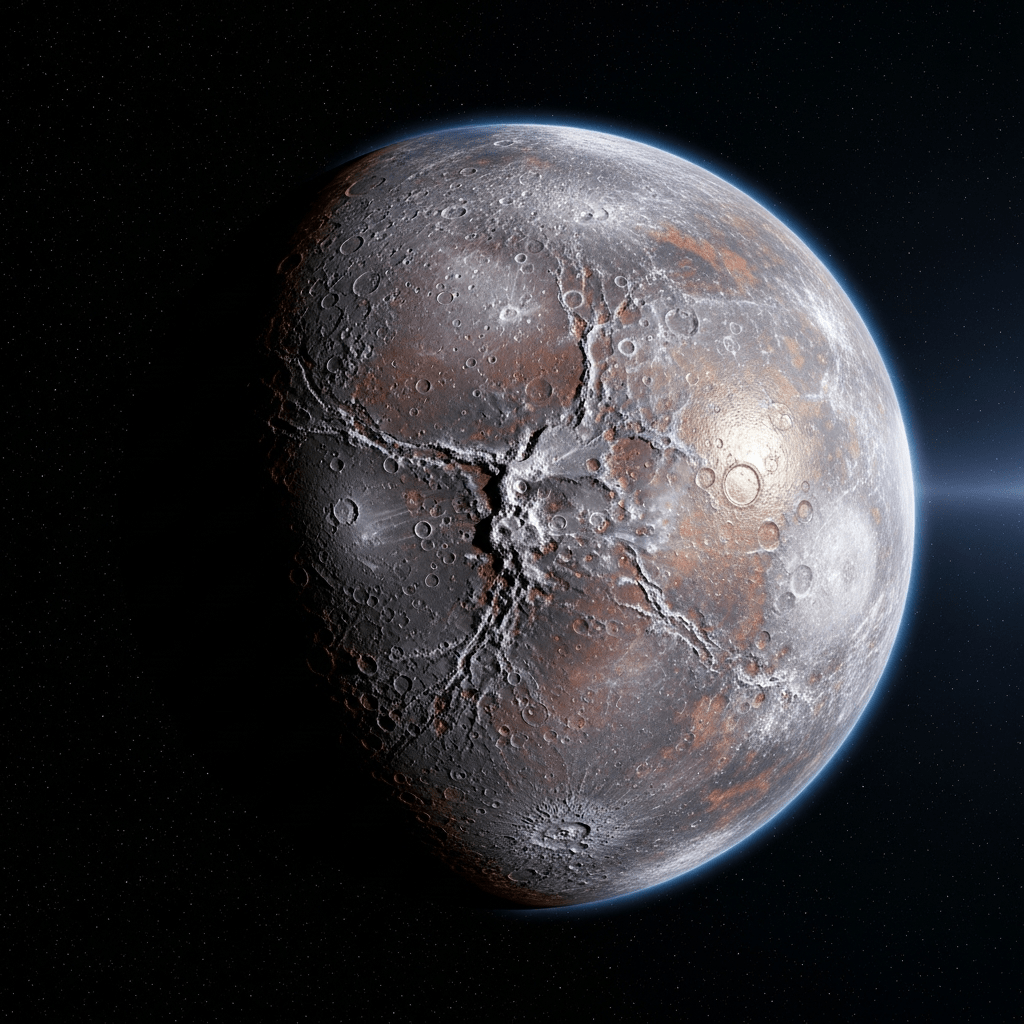
Mercurian Planet
A Mercurian planet is a terrestrial world distinguished by an unusually large iron core, resulting in a high density relative to its size.
A Mercurian planet is a terrestrial world distinguished by an unusually large iron core, resulting in a high density relative to its size.
The concept of Mercurian or iron-rich planets arises from detailed studies of Mercury’s unique interior, particularly its disproportionately large metallic core compared to its silicate mantle. This classification emerged from planetary formation research in the late 20th century, formalized through investigations into Mercury’s structure and formation scenarios such as giant impact stripping or selective condensation in the early solar nebula.
Mercurian planets belong to the terrestrial category of planets, characterized by rocky compositions. They are defined primarily by their high iron-to-silicate ratio and large core fraction, setting them apart from typical rocky planets with more balanced metal-to-silicate interiors. This type overlaps with terms like iron-rich or metal-rich planets and is recognized both in Solar System studies and exoplanet research.
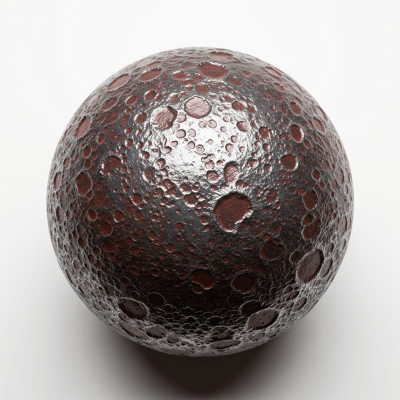
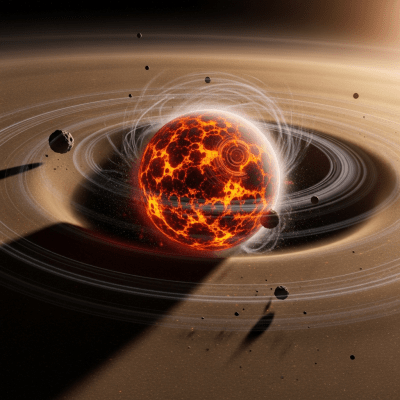
These planets feature a solid surface dominated by a large metallic core enveloped by a thin silicate mantle and crust. Their high density gives them a compact form smaller than Earth but with a core that can comprise about 70% of the planet’s mass, as seen in Mercury.
Mercurian planets typically lack significant atmospheres, possessing only tenuous exospheres composed of elements like sodium and potassium. Their iron-rich interiors influence magnetic field generation and geological activity, though their small size and volatile depletion limit atmospheric retention and surface weathering processes.
Bring this kind into your world illustrated posters, mugs, and shirts.
Archival print, museum-grade paper
Buy Poster
Stoneware mug, dishwasher safe
Buy Mug
Soft cotton tee, unisex sizes
Buy ShirtMercury, the archetype of Mercurian planets, has held a prominent place in human culture and mythology as the swift messenger of the gods. Its unique physical traits have inspired scientific curiosity and artistic representation, symbolizing resilience and mystery in both ancient lore and modern planetary science.
Mercurian planets do not have intrinsic orbital constraints but are exemplified by Mercury’s close orbit at about 0.39 astronomical units from its star, completing an orbit every 88 Earth days. Their orbital eccentricity can vary, but the defining traits lie in composition rather than orbit.
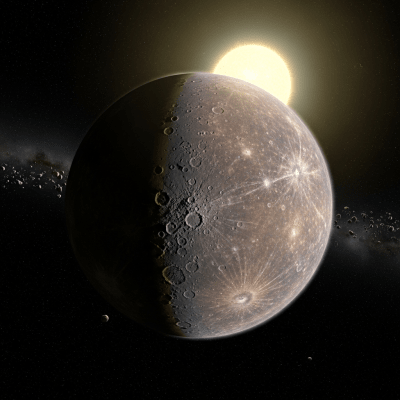
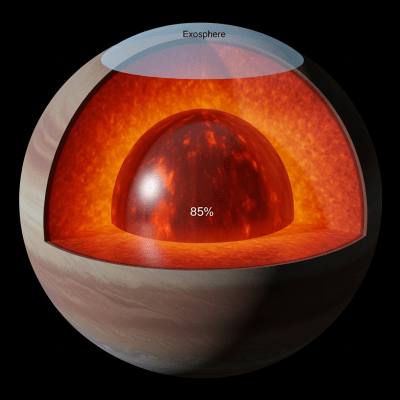
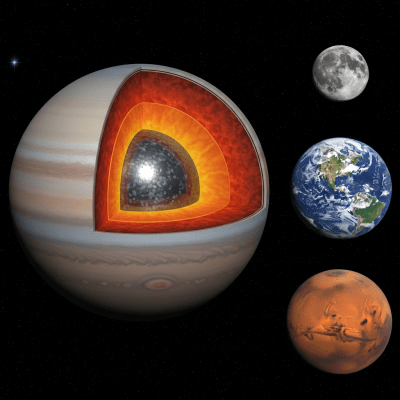
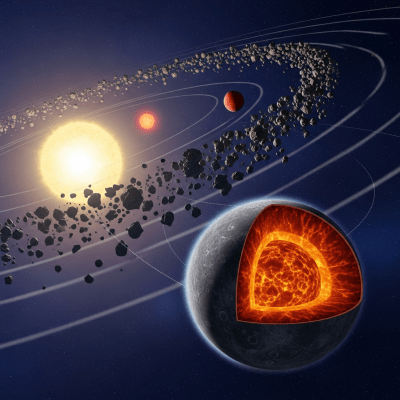
These planets typically have masses ranging from about 0.05 Earth masses, as with Mercury, up to near Earth mass. Their radius is smaller than Earth’s, with Mercury’s radius at 0.383 Earth radii. Mean density exceeds 5 grams per cubic centimeter, reflecting a dominant iron-nickel core that can constitute roughly 70% of the planet’s mass, surrounded by a thin silicate mantle and crust.
Mercurian planets generally lack a significant atmosphere. Mercury itself has a tenuous exosphere composed mainly of sodium, potassium, calcium, magnesium, and oxygen atoms, which is extremely thin and transient. This minimal atmospheric presence results from the planet’s weak gravity and proximity to the Sun, which strips away lighter gases.
Mercury has been explored by several missions, most notably NASA’s Mariner 10 in the 1970s and the MESSENGER spacecraft, which orbited Mercury from 2011 to 2015. These missions provided detailed data on Mercury’s composition, magnetic field, and surface, confirming its large core and iron-rich nature. No direct exploration of Mercurian exoplanets has yet occurred, but their existence is inferred from mass-radius measurements.
Due to their small size, lack of substantial atmosphere, and often extreme temperatures, Mercurian planets are considered inhospitable to life as we know it. Their iron-rich composition and volatile depletion limit the potential for stable surface conditions or liquid water, reducing prospects for habitability or colonization.