Circumbinary Planet
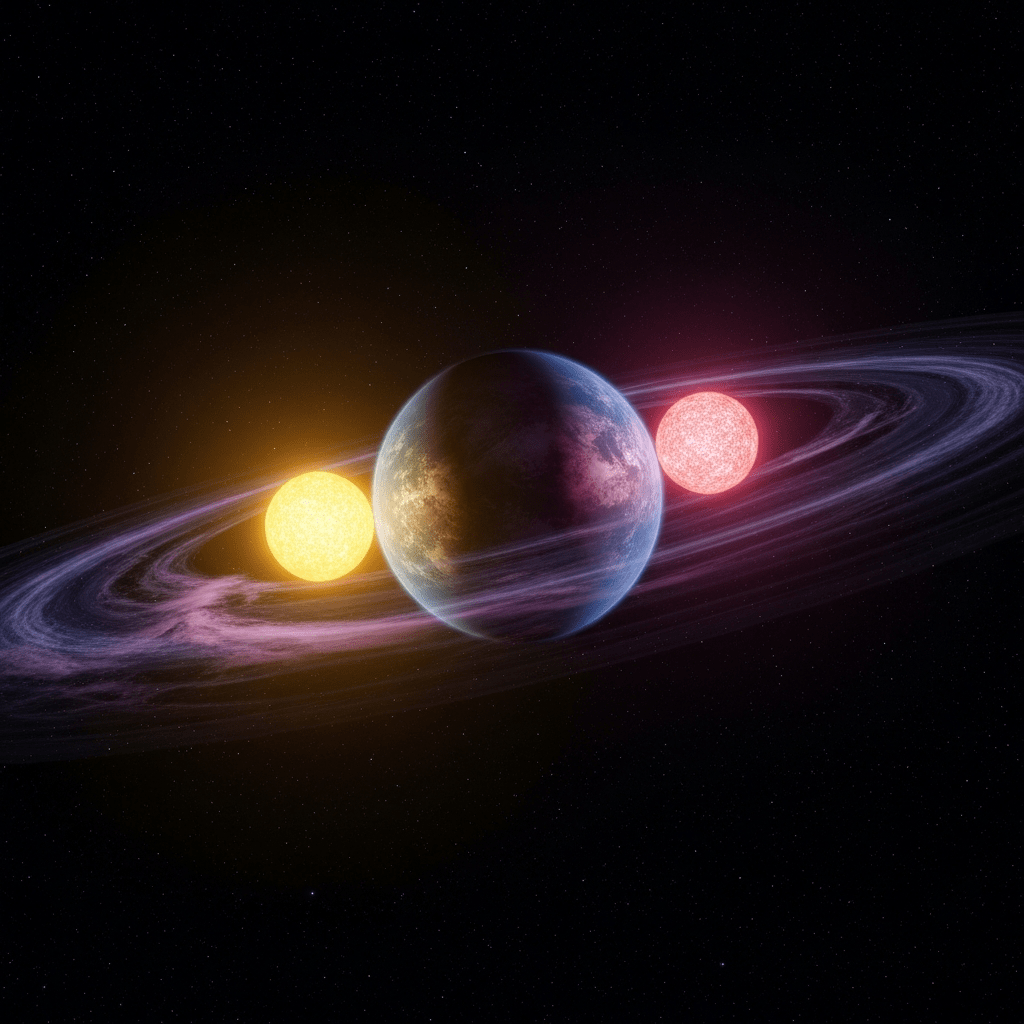
A circumbinary planet is a world that orbits around both stars of a binary star system, revolving around their common center of mass rather than a single star.
A circumbinary planet is a world that orbits around both stars of a binary star system, revolving around their common center of mass rather than a single star.
The concept of circumbinary planets arose from theoretical studies of planetary dynamics in binary star systems, with the first confirmed discovery made by NASA's Kepler mission in 2011 through the detection of Kepler-16b. This classification is grounded in dynamical astronomy and has since been supported by multiple confirmed detections, expanding our understanding of planet formation in complex stellar environments.
Circumbinary planets belong to a dynamical class defined by their unique orbital configuration: they orbit the barycenter of a binary star system rather than a single star. This distinguishes them from typical circumstellar planets and places them within the broader taxonomy of planetary system architectures. While their composition and mass can vary widely, their defining trait is their orbit around two stars.
Visually, circumbinary planets can range from gas giants to smaller sub-Neptune worlds, though no direct imaging has yet revealed their appearance. Their form depends on their intrinsic properties, but they are typically found orbiting beyond the dynamically unstable zone created by the binary stars' gravitational interplay, often at distances several times the stars' separation.
Functionally, circumbinary planets showcase the remarkable stability possible in multi-star systems, maintaining orbits that balance the gravitational forces of two stars. While they do not have direct interaction or utility for humans, their study informs models of planet formation and orbital dynamics in environments once thought too chaotic for stable planets.
Bring this kind into your world illustrated posters, mugs, and shirts.

Archival print, museum-grade paper
Buy Poster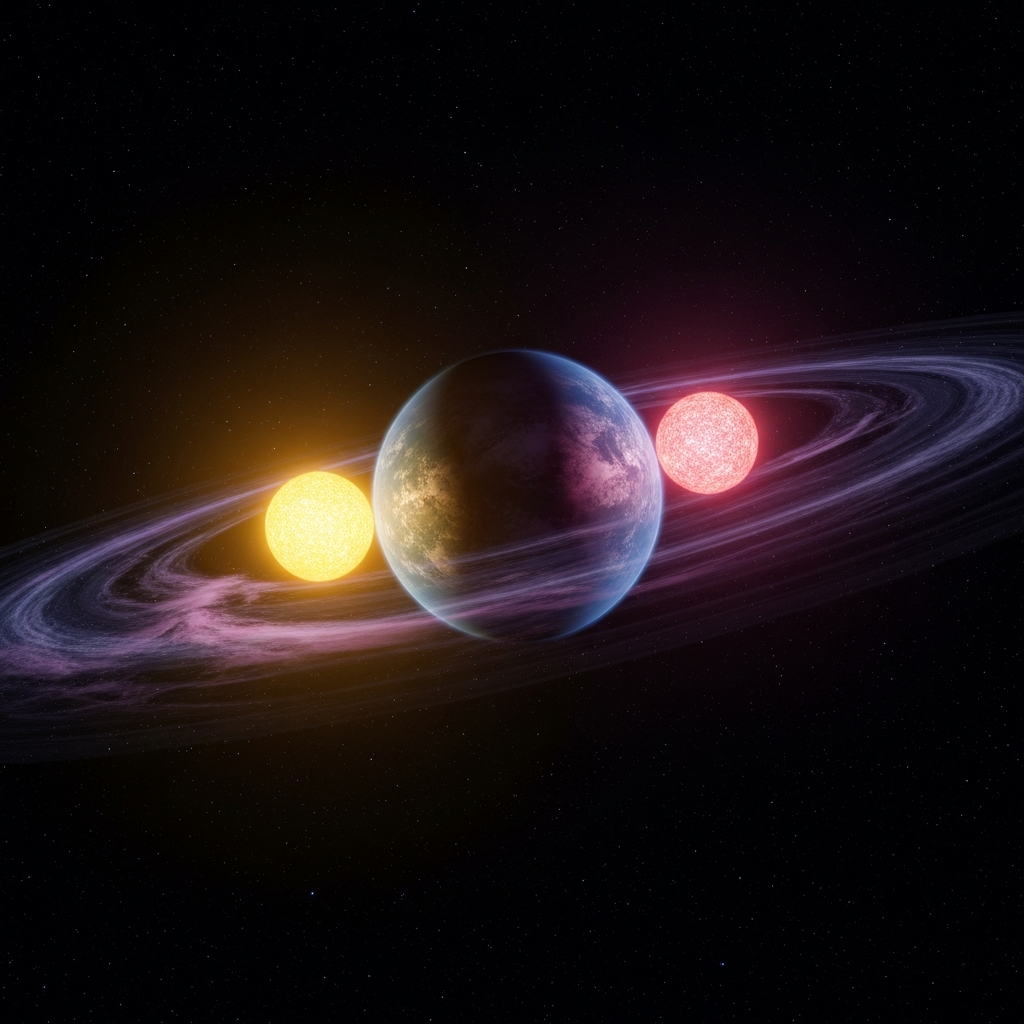
Stoneware mug, dishwasher safe
Buy Mug
Soft cotton tee, unisex sizes
Buy ShirtCircumbinary planets have captured public imagination through science fiction and popular media, often depicted as exotic worlds with dual suns, such as the iconic planet Tatooine in Star Wars. Their real discovery has fueled interest in diverse planetary systems and broadened cultural perspectives on the variety of possible worlds.
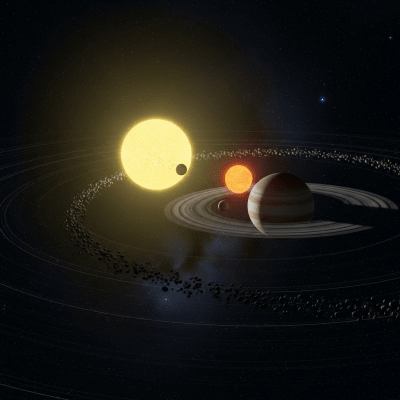
These planets orbit the barycenter of their host binary stars, typically at distances greater than two to four times the stars' separation to maintain orbital stability. Their orbital periods vary widely, from about 49 days in the case of Kepler-16b to several years for other known examples. The exact orbit depends on the binary stars' mass ratio, eccentricity, and separation, with stable zones carefully defined by dynamical models.



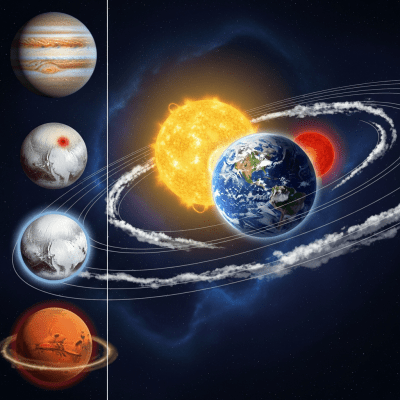

Physical properties of circumbinary planets vary, encompassing gas giants like Kepler-16b (~0.33 Jupiter masses) and smaller sub-Neptune-sized worlds. Due to limited direct measurements, mass and radius ranges are broad and compositionally diverse, including both gaseous and potentially rocky planets. Their densities and internal structures remain largely unconstrained.
Currently, no direct atmospheric characterization exists for circumbinary planets. Their atmospheres, if present, likely reflect their composition—ranging from thick gaseous envelopes in gas giants to thinner atmospheres in smaller planets. The complex radiation environment from two stars may influence atmospheric dynamics and composition.
Human exploration of circumbinary planets is limited to remote observations. The Kepler mission was pivotal in their discovery, with Kepler-16b marking the first confirmed case in 2011. Subsequent detections by Kepler and other observatories have expanded the known population, but no spacecraft missions have directly studied these planets.
Habitability of circumbinary planets depends on their orbit within the habitable zone, which is more complex due to the influence of two stars. Stable orbits in this zone are possible, but fluctuating radiation and gravitational effects pose challenges. While some circumbinary planets may possess conditions suitable for life, definitive assessments await further study.