Origin Story

Callistoctopus macropus was first formally described by Risso in 1826, with its type specimen originating from the Mediterranean region. This species has a well-established lineage within the genus Callistoctopus, known for elongated arms and distinctive coloration, situating it firmly within the family Octopodidae.

Classification

The Atlantic White-Spotted Octopus belongs to the order Octopoda, which encompasses all true octopuses. Within this order, it is classified in the family Octopodidae and the genus Callistoctopus. This taxonomic placement reflects its morphological traits such as long slender arms and characteristic coloration patterns.

Appearance or Form

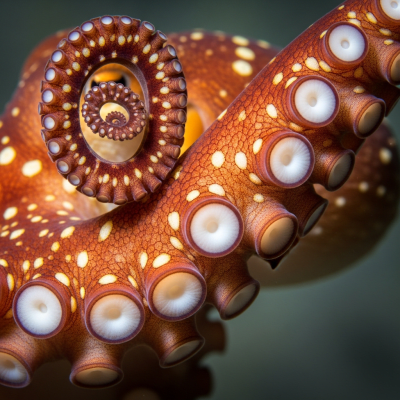
This octopus displays a striking deep red coloration covered with numerous small, bright white spots scattered across its body and arms. Adults typically have a mantle length ranging from 8 to 20 centimeters and can reach an arm span of up to one meter. Its arms are notably long and slender—often more than four times the mantle length—and bear two rows of suckers, enhancing its dexterity and sensory capabilities.

Behavior or Usage

The Atlantic White-Spotted Octopus is primarily nocturnal, emerging at night to hunt for crustaceans, mollusks, and small fish. During daylight hours, it seeks shelter in crevices or beneath rocks on sandy or rocky substrates. Its behavior reflects adaptation to both predation and camouflage within its coastal habitat.

Merchandise & Prints

Bring this kind into your world � illustrated posters, mugs, and shirts.

Atlantic White-Spotted Octopus Atlantic White-Spotted Octopus Poster

Atlantic White-Spotted Octopus Poster

Archival print, museum-grade paper

Atlantic White-Spotted Octopus Atlantic White-Spotted Octopus Mug

Atlantic White-Spotted Octopus Mug

Stoneware mug, dishwasher safe

Atlantic White-Spotted Octopus Atlantic White-Spotted Octopus Shirt

Atlantic White-Spotted Octopus Shirt

Soft cotton tee, unisex sizes

Attributes & Insights

Taxon-Specific Insights

🌍Cultural Significance

While not widely prominent in global culture, the Atlantic White-Spotted Octopus holds regional culinary significance in Mediterranean and Atlantic coastal communities, where it is occasionally harvested and prepared in local dishes. It is known locally in Italian as "Polpo macropo." Beyond culinary uses, there is limited documented cultural or symbolic importance.

📌Notable Facts

  • Its arms can be more than four times the length of its mantle, making it exceptionally slender and agile.
  • The species exhibits a distinctive pattern of bright white spots contrasting against a deep red body.
  • It is nocturnal, preferring to hide during the day and actively forage at night.
  • Despite its striking appearance, it is less commercially exploited than other Mediterranean octopus species.
  • Known synonyms include Octopus macropus and Polypus macropus, reflecting its taxonomic history.

🌊Habitat And Distribution

The Atlantic White-Spotted Octopus thrives in shallow coastal waters of the Mediterranean Sea and the eastern Atlantic Ocean. It favors sandy and rocky substrates where it can find shelter during the day and forage effectively at night. Its ecological niche involves crevice hiding and nocturnal hunting in these temperate marine environments.

Visual Variations

High quality studio photograph of a single Atlantic White-Spotted Octopus
A realistic underwater scene featuring a Atlantic White-Spotted Octopus of the taxonomy octopuses in its natural marine environment
Naturalistic close-up photograph of a single arm of a Atlantic White-Spotted Octopus, focusing on the suckers, skin texture, and coloration details
Illustration of a Atlantic White-Spotted Octopus displaying camouflage behavior within its environment, blending into rocks, sand, or coral

Composition & Context

Taxon-Specific Insights

🧠Intelligence And Cognition

Like other octopuses, Callistoctopus macropus demonstrates notable intelligence, including problem-solving abilities and adaptive hunting strategies. Its nocturnal foraging behavior and use of shelter indicate advanced environmental awareness and survival tactics common among octopods.

🛡️Defense Mechanisms

This species relies on camouflage and concealment as primary defense strategies, hiding in crevices or under rocks during daylight to avoid predators. Its vivid coloration may also serve as disruptive patterning among the rocky and sandy seafloor, while its agility and ability to squeeze into tight spaces provide additional protection.

🔄Reproduction And Lifecycle

Although specific reproductive details for the Atlantic White-Spotted Octopus are limited, it likely follows typical octopus patterns: females lay eggs in protected dens, tending them until hatching, with a lifespan estimated between one and two years. This short lifecycle aligns with many benthic octopus species.

⚠️Conservation And Threats

No formal conservation status has been assigned to the Atlantic White-Spotted Octopus. While it faces no known major threats, localized fishing pressure exists due to occasional artisanal harvesting. Habitat degradation in coastal areas could impact populations, but current data are insufficient to assess long-term risks.

Faq

Q: Where is the Atlantic White-Spotted Octopus commonly found?
The species inhabits shallow coastal waters of the Mediterranean Sea and eastern Atlantic Ocean.

Q: What does it eat?
It feeds mainly on crustaceans, mollusks, and small fish.

Q: Is this species commercially important?
It is occasionally harvested for food locally but is not a major target of large-scale fisheries.