Mica
Mica is a group of sheet silicate minerals renowned for their ability to split into thin, flexible, and heat-resistant layers, making them essential in both nature and industry.
Mica is a group of sheet silicate minerals renowned for their ability to split into thin, flexible, and heat-resistant layers, making them essential in both nature and industry.
The name "mica" stems from the Latin micare, meaning "to glitter," a nod to its sparkling appearance. Mica minerals have been recognized since antiquity, with muscovite and biotite described in mineralogical texts as early as the 18th century. The group is formally acknowledged by the International Mineralogical Association (IMA) and comprises several closely related minerals, each with its own unique history and geological context.
Mica belongs to the phyllosilicate class of minerals, specifically the mica group, characterized by their sheet-like atomic structure. Within mineral classification systems, micas are placed under Dana code 71.02.01 and Strunz code 9.EC.15, reflecting their distinctive layered arrangement and silicate chemistry. The group includes several species, such as muscovite, biotite, phlogopite, and lepidolite, each defined by subtle chemical variations.
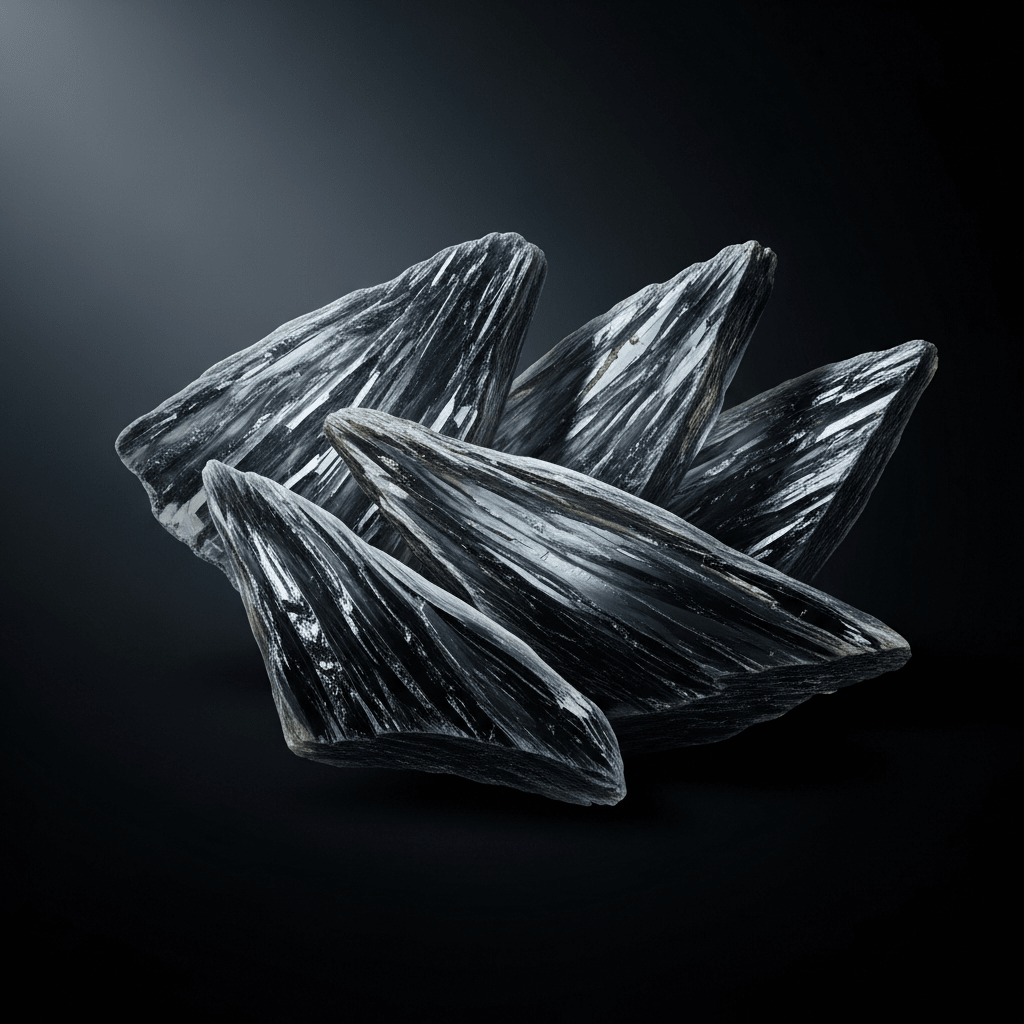
Micas are instantly recognizable by their ability to cleave into extremely thin, elastic sheets. These layers are often transparent or translucent, with muscovite presenting a silvery or pale brown hue, biotite appearing dark brown to black, phlogopite showing brownish-yellow tones, and lepidolite displaying lilac to rose colors. Their luster ranges from vitreous to pearly, and the sheets shimmer when moved under light, giving mica its signature sparkle.
Mica's unique structure allows it to act as an excellent insulator against heat and electricity. Its flexibility and resistance to thermal stress make it invaluable in electronics (such as capacitors and insulators), paints, plastics, and cosmetics, where it imparts a glittering effect. Historically, transparent muscovite sheets were used as window glass, known as "isinglass." In nature, micas play a key role in the formation and stability of igneous and metamorphic rocks.
Bring this kind into your world illustrated posters, mugs, and shirts.
Archival print, museum-grade paper
Buy Poster
Stoneware mug, dishwasher safe
Buy Mug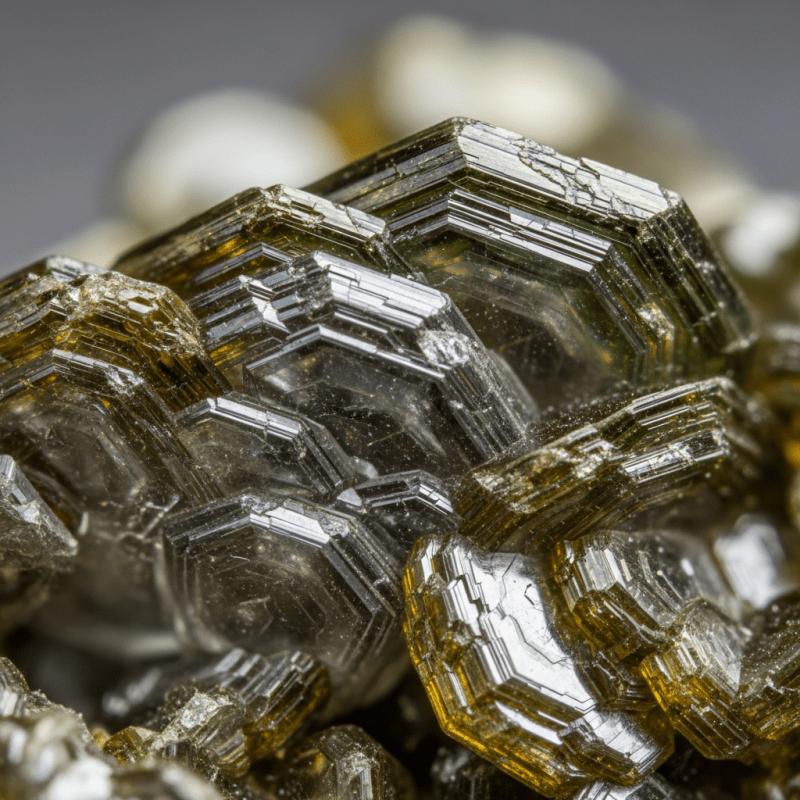
Soft cotton tee, unisex sizes
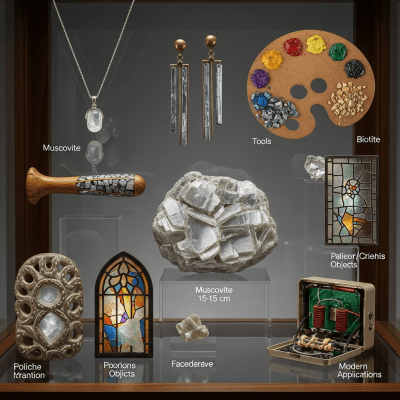
Buy ShirtThroughout history, mica has been prized for its shimmering beauty and utility. Ancient cultures incorporated mica into artifacts and decorative objects, leveraging its reflective qualities. In modern times, its use in cosmetics and interior design continues to celebrate its aesthetic appeal, while its role in technological advancement underscores its enduring value.
Micas have a general chemical formula of AB₂–₃(X₄O₁₀)(OH,F)₂, where A is typically potassium, sodium, or calcium; B is aluminum, magnesium, or iron; and X is silicon or aluminum. Each species, such as muscovite (KAl₂(AlSi₃O₁₀)(OH)₂) or biotite (K(Mg,Fe)₃(AlSi₃O₁₀)(OH)₂), is defined by its specific elemental makeup.

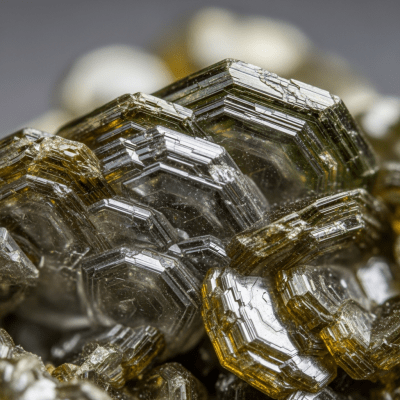
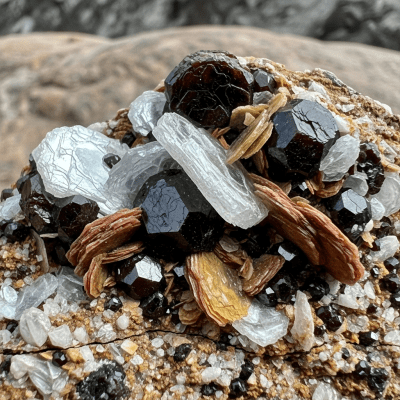
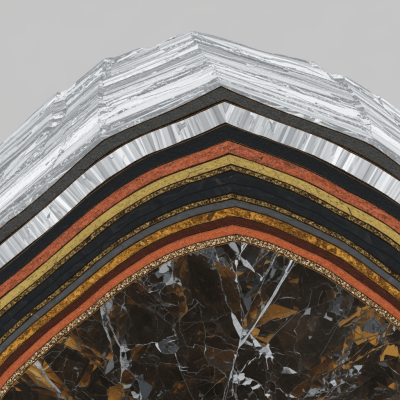
Mica minerals crystallize in the monoclinic system but often appear pseudohexagonal due to their sheet-like atomic arrangement. Their structure consists of stacked layers of silicate tetrahedra, which enables perfect basal cleavage and the formation of thin, flexible sheets.
Micas are abundant in igneous and metamorphic rocks, such as granite, schist, and gneiss. Muscovite and biotite are common in granites and schists, phlogopite is found in ultramafic rocks like kimberlite, and lepidolite occurs in lithium-rich pegmatites. Their presence often indicates specific geological conditions and can help identify rock types.
Mica's thermal and electrical insulating properties make it indispensable in electronics, especially for capacitors and insulators. It is also used as a glittering agent in paints, plastics, and cosmetics, and as a filler in construction materials. Historically, muscovite sheets served as window glass, and lepidolite is mined as a source of lithium for batteries.
Notable mica specimens include large muscovite sheets historically used as "isinglass" window panes, vibrant lepidolite masses from lithium-rich pegmatites, and ruby mica from India. Museums and mineral collections often feature impressive stacks of muscovite and biotite, showcasing their perfect cleavage and shimmering beauty.