Chalcopyrite
Chalcopyrite is a brassy yellow copper iron sulfide mineral, renowned as the world’s most important copper ore and easily recognized by its metallic luster and distinctive crystal form.
Chalcopyrite is a brassy yellow copper iron sulfide mineral, renowned as the world’s most important copper ore and easily recognized by its metallic luster and distinctive crystal form.
First described in 1725 by Johann Friedrich Henckel, chalcopyrite’s name blends the Greek words chalkos (copper) and pyrites (strike fire), reflecting its copper content and resemblance to pyrite. Its formal recognition and classification by the International Mineralogical Association cement its status as a canonical mineral species. Chalcopyrite’s widespread presence in geological deposits has made it a cornerstone of copper mining since its discovery.
Chalcopyrite belongs to the sulfide mineral group, characterized by its combination of metals and sulfur. It is classified under the Dana system as 2.9.1.1 and the Strunz system as 2/D.10-1 (10.2.1), marking its place among copper iron sulfides. Its unique chemical formula and crystal structure distinguish it as a mineral species rather than a variety or subtype.
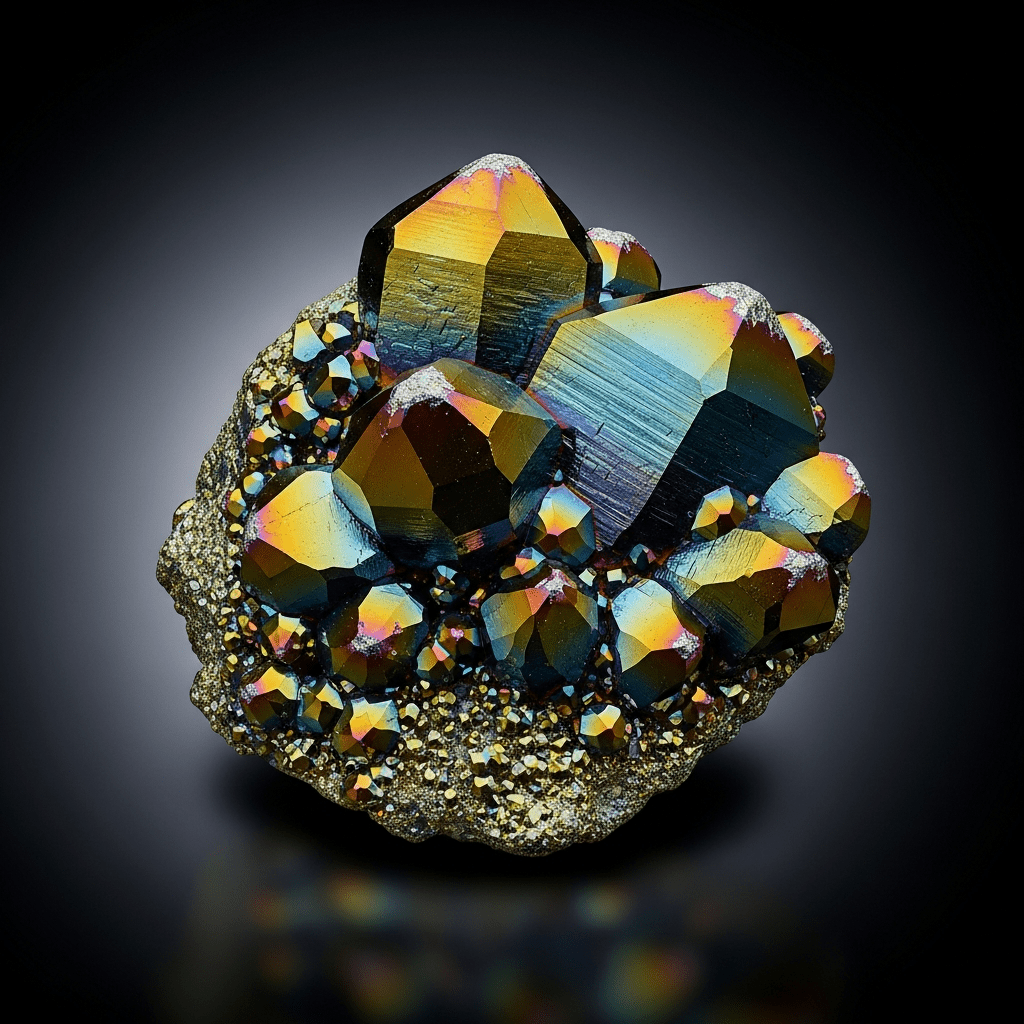
Chalcopyrite typically displays a brassy to golden yellow color, often with a metallic sheen that catches the light. Its crystals are most commonly found in tetragonal forms, but massive and granular habits are also frequent. Specimens may tarnish to vivid iridescent hues—purple, blue, or red—due to surface oxidation, and its streak is a characteristic greenish-black. The mineral is opaque, brittle, and has poor cleavage, contributing to its rugged, industrial appearance.
As the principal source of copper worldwide, chalcopyrite is extensively mined and processed for industrial copper production. Its role in the global economy is immense, underpinning electrical, construction, and technological industries. While occasionally cut as a gemstone or collected for its aesthetic appeal, its primary interaction with humans is through mining and metallurgy.
Bring this kind into your world illustrated posters, mugs, and shirts.

Archival print, museum-grade paper
Buy Poster
Stoneware mug, dishwasher safe
Buy Mug
Soft cotton tee, unisex sizes
Buy ShirtChalcopyrite’s resemblance to gold has led to its occasional misidentification as “fool’s gold,” a term more accurately applied to pyrite. While it lacks deep mythological or artistic roots, its economic importance has shaped societies dependent on copper for tools, currency, and technology. Tarnished specimens, sometimes marketed as “peacock ore,” have found a niche in mineral collecting for their vibrant colors.
Chalcopyrite’s chemical formula is CuFeS₂, comprising copper, iron, and sulfur in a 1:1:2 ratio. This composition makes it a key source of copper and distinguishes it from other sulfide minerals.
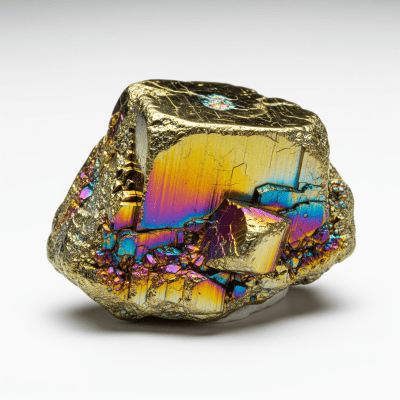
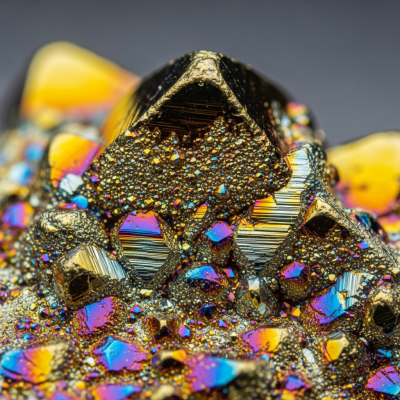
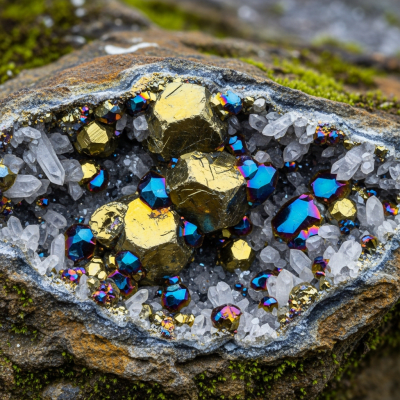
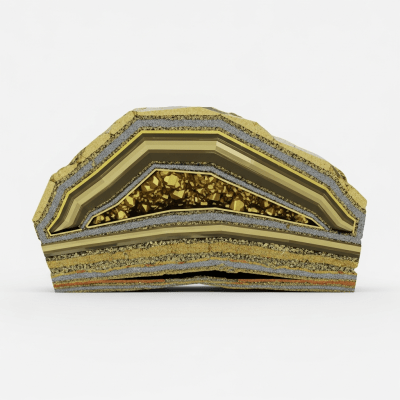

Chalcopyrite crystallizes in the tetragonal system, specifically in the space group I-42d. Its crystals are often well-formed, displaying sharp edges and symmetry, though massive and granular forms are also common.
Chalcopyrite is widespread in nature, most notably in hydrothermal veins, contact metamorphic rocks, and disseminated throughout igneous formations such as porphyry copper deposits. It is frequently found alongside minerals like pyrite, bornite, sphalerite, and galena, forming extensive ore bodies that are crucial for copper extraction.
Chalcopyrite is primarily mined as the chief source of copper, which is essential for electrical wiring, plumbing, and countless technological applications. Its extraction and processing drive major industries and global trade. Minor uses include ornamental stone and mineral specimens for collectors, but its industrial role far outweighs these.
While chalcopyrite is abundant, large, well-formed crystals from localities such as the Huanzala Mine (Peru) and the Tsumeb Mine (Namibia) are prized by collectors. Specimens exhibiting vivid iridescent tarnish, though less scientifically significant, are highly sought after for their beauty and are sometimes displayed in mineral museums and collections worldwide.