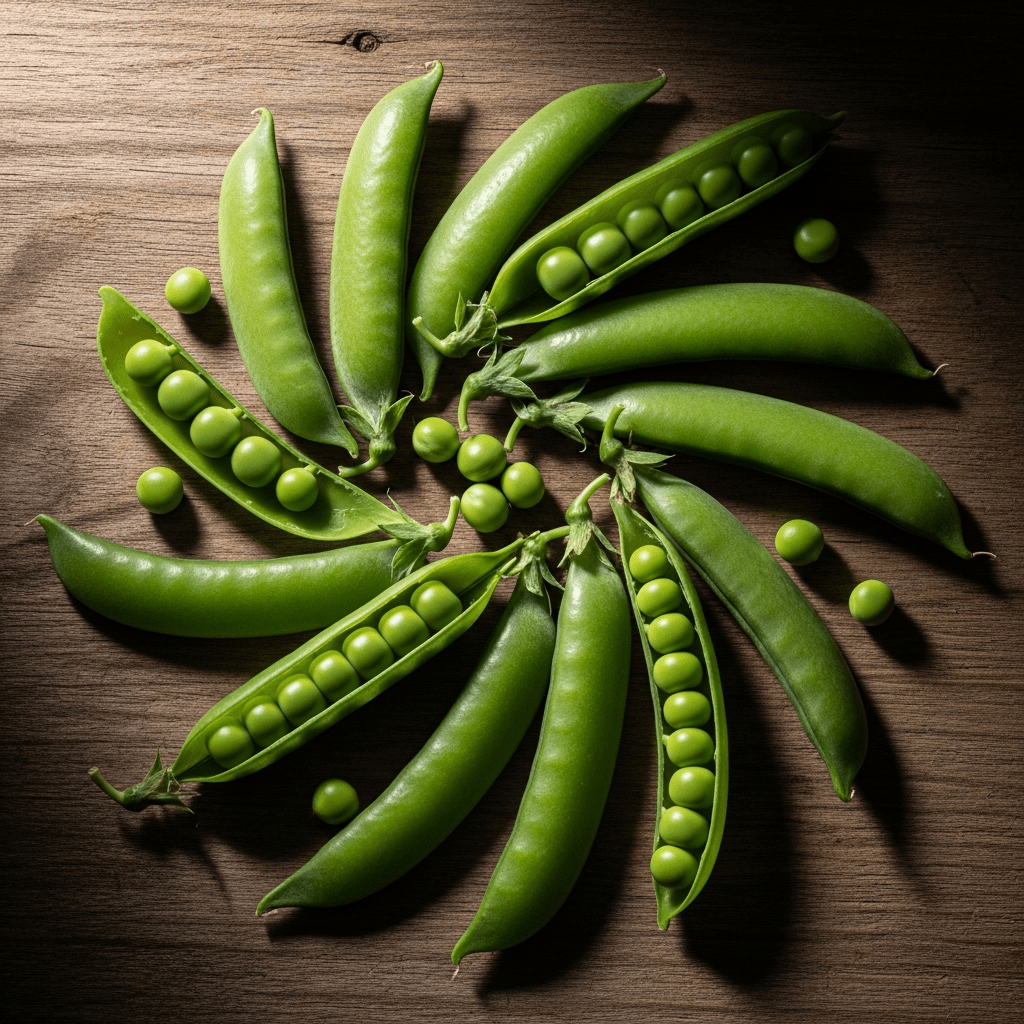
Pea
The pea (Pisum sativum) is an annual legume cultivated worldwide for its edible seeds and pods, prized for their nutrition, versatility, and role in sustainable agriculture.
The pea (Pisum sativum) is an annual legume cultivated worldwide for its edible seeds and pods, prized for their nutrition, versatility, and role in sustainable agriculture.
Peas originated in the Mediterranean basin and western Asia, with archaeological evidence tracing their domestication back at least 7,000–10,000 years. Early Neolithic farmers selected wild relatives such as Pisum sativum subsp. elatius and Pisum fulvum, gradually spreading the crop throughout Europe, Asia, and eventually across the globe. This long history is reflected in the diverse cultivars and regional traditions associated with peas today.
Botanically, the pea belongs to the Fabaceae (Leguminosae) family, within the subfamily Faboideae, genus Pisum, and species Pisum sativum. It is a true legume, sharing the family with beans, lentils, and chickpeas, and is often classified as both a vegetable and a pulse depending on its use. Cultivars are further distinguished by pod type and seed traits, such as garden peas, snow peas, and sugar snap peas.
Pea plants are slender, herbaceous annuals that typically reach 0.5–2 meters in height. Their climbing stems are supported by delicate tendrils, and pinnate leaves bear 1–3 pairs of leaflets. The flowers, which may be white, pink, or purple, are self-pollinating and often fragrant. Pods range from 5–10 cm, straight or curved, with smooth or wrinkled textures depending on variety. Seeds are round to slightly angular, commonly green or yellow, and can be smooth or wrinkled.
Peas serve multiple roles: as a fresh vegetable, dried pulse, forage crop, cover crop, and even a source of plant protein for industrial uses. They are valued for their ability to fix atmospheric nitrogen, enriching soil for subsequent crops. Humans interact with peas across culinary, agricultural, and ecological domains, consuming them in diverse dishes, using them for animal feed, and integrating them into crop rotations for sustainable farming.
Bring this kind into your world illustrated posters, mugs, and shirts.
Archival print, museum-grade paper
Buy Poster
Stoneware mug, dishwasher safe
Buy Mug
Soft cotton tee, unisex sizes
Buy ShirtPeas hold a storied place in human culture. They were central to Gregor Mendel’s foundational genetic experiments, shaping the science of heredity. In cuisine, peas appear in traditional dishes from European pea soups to Indian dal. Their imagery and symbolism are found in folklore, literature, and even fairy tales, such as "The Princess and the Pea." Across languages and regions, peas evoke notions of simplicity, nourishment, and agricultural heritage.
Peas were domesticated by Neolithic farmers in the Near East and Mediterranean, with cultivation dating back 7,000–10,000 years. The crop spread through Europe and Asia, adapting to diverse climates and uses. Modern breeding has produced varieties with improved pod types, seed size, sweetness, and disease resistance. Wild ancestors such as Pisum sativum subsp. elatius and Pisum fulvum contributed genetic diversity. Mendel’s 19th-century experiments with peas established the foundations of classical genetics, further cementing their historical significance.

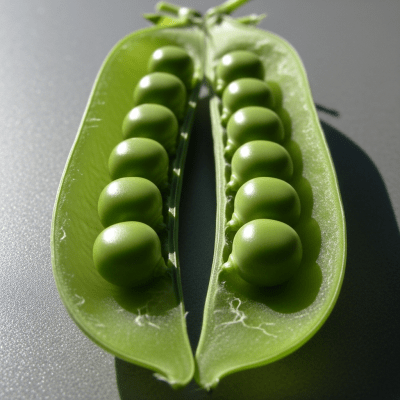
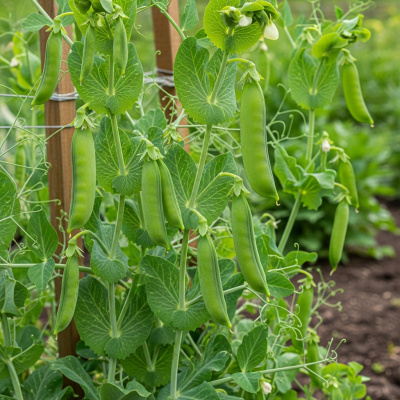
Pea plants are annuals, completing their lifecycle within a single growing season. Growth habit varies: some cultivars are determinate, maturing uniformly, while others are indeterminate, producing over an extended period. Plants climb via slender stems and tendrils, reaching up to 2 meters. Flowering precedes pod development, with pods maturing in 60–90 days under optimal conditions. Harvest timing depends on intended use—immature pods for snow and sugar snap peas, mature seeds for garden and split peas.
Like all true legumes, peas form a symbiotic relationship with nitrogen-fixing bacteria (Rhizobium leguminosarum) in their root nodules. This process converts atmospheric nitrogen into forms usable by plants, reducing the need for synthetic fertilizers and improving soil fertility. Pea crops can contribute 50–150 kg of nitrogen per hectare, making them valuable in crop rotations and sustainable agriculture.
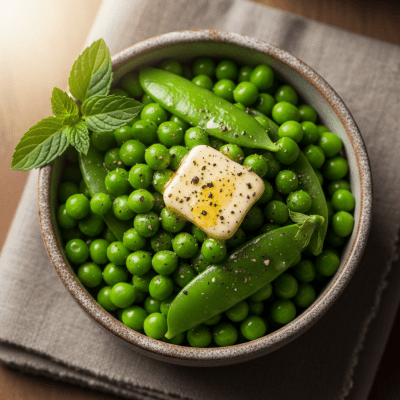
Peas are enjoyed in myriad culinary forms: fresh green seeds (garden peas) are eaten raw, steamed, or boiled; snow peas and sugar snap peas are prized for their tender, sweet pods in stir-fries and salads; dried peas are split for soups, purees, and traditional dishes like Indian dal and European pea soup. Peas are high in protein, fiber, vitamins, and minerals, making them a nutritious staple. Industrial uses include extraction of pea protein for plant-based foods and animal feed.
Peas are a major global crop, produced extensively in China, India, Russia, Canada, and France. They are traded internationally as both fresh and dried products, with regulatory codes such as FAO 0177 (dry peas) and USDA PLANTS symbol PISA2. Peas serve food, forage, and industrial markets, reflecting their economic and agricultural significance worldwide.
Pea cultivars exhibit varying resistance to diseases and pests. Some are tolerant to powdery mildew and moderately resistant to fusarium wilt. However, susceptibility to root rot, pea enation mosaic virus, and aphid infestations remains a challenge. Breeding programs continue to enhance resistance traits, contributing to crop reliability and yield stability.
Peas are known by many names and varieties across regions. Scientific synonyms include Pisum arvense (field pea). Vernacular names encompass "garden pea" (English), "pois" (French), "Erbse" (German), "arveja" (Spanish), "matar" (Hindi), and "batani" (Russian). Snow peas are also called "Chinese pea pod," and sugar snap peas are "snap peas." Heritage varieties such as ‘Lincoln’, ‘Wando’, ‘Kelvedon Wonder’, and ‘Sugar Ann’ reflect local breeding and culinary traditions.