Origin Story

First described by Johann von Schreber in 1777, the European Wildcat originated in the forests of continental Europe. Its evolutionary lineage is closely intertwined with the development of domestic cats, tracing back to ancient wildcat populations that roamed central and western Europe. Early naturalists collected specimens across these regions, laying the foundation for its scientific recognition and highlighting its importance in the ancestry of modern felines.

Classification

The European Wildcat belongs to the family Felidae, subfamily Felinae, and genus Felis. Its species designation is Felis silvestris, with several recognized subspecies including the nominate Felis silvestris silvestris, the Caucasian wildcat (F. s. caucasica), Scottish wildcat (F. s. grampia), and others. As a member of Felinae, it shares close genetic ties with the African wildcat and domestic cat, forming a distinct lineage within the broader cat family.

Appearance or Form

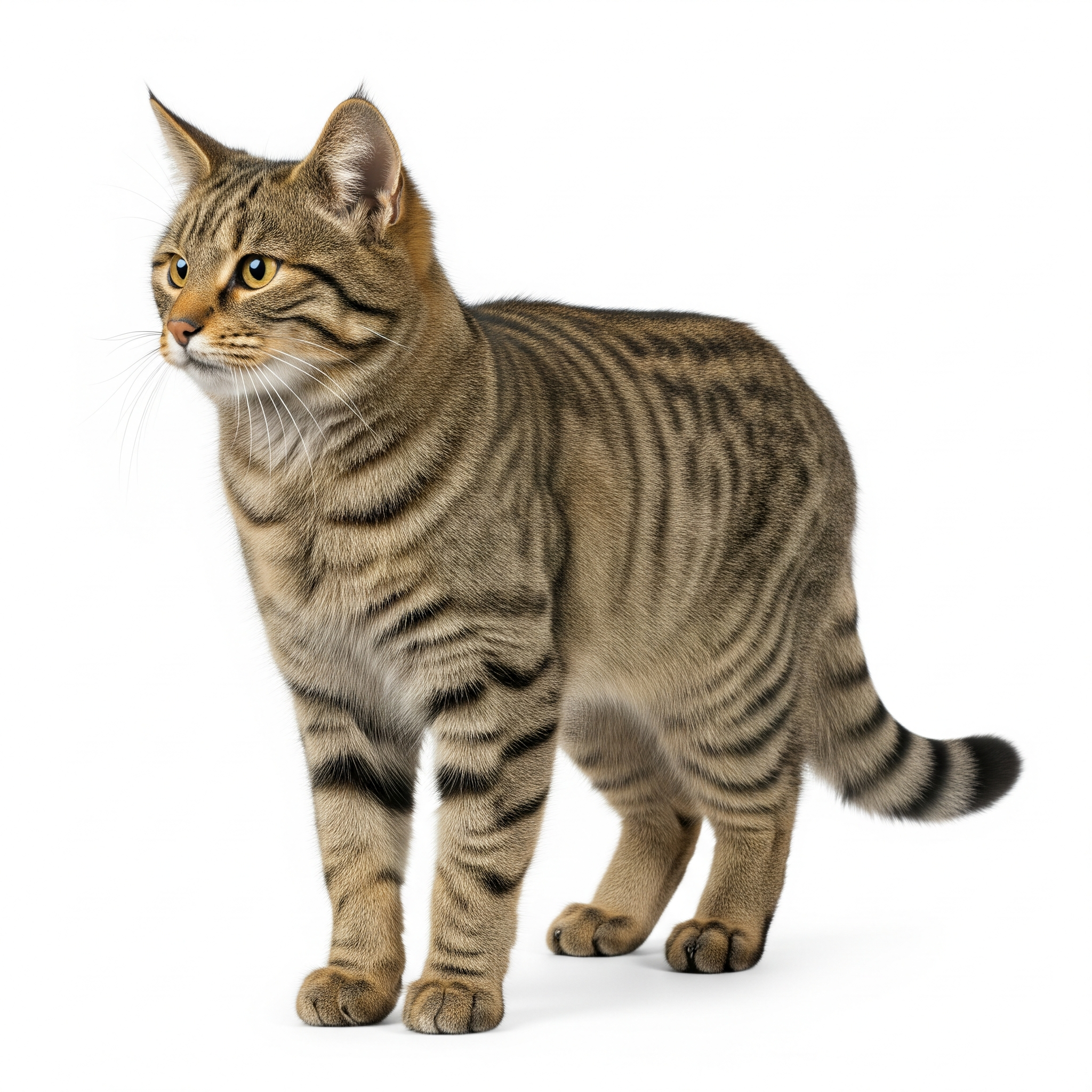
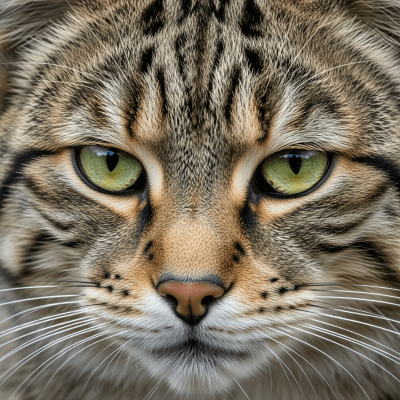
The European Wildcat is characterized by its muscular build, broad head, and short muzzle. Its dense, grey to brownish fur is adorned with bold black stripes and spots, most prominent on the flanks and legs. The tail is thick and bushy, marked by several dark rings and ending in a blunt black tip—a key trait for identification. These tabby-like markings, combined with a wild, alert expression, set it apart from both domestic cats and other wild felines.

Behavior or Usage

Solitary and primarily nocturnal, the European Wildcat is fiercely territorial, using scent marking to define its range. It is an obligate carnivore, hunting small mammals—especially rodents—along with birds, reptiles, and amphibians. As a mesopredator, it plays a crucial role in maintaining ecological balance by regulating prey populations. Interaction with humans is limited, though hybridization with domestic cats poses significant challenges for conservation.

Merchandise & Prints

Bring this kind into your world � illustrated posters, mugs, and shirts.

Felis silvestris Felis silvestris Poster

Felis silvestris Poster

Archival print, museum-grade paper

Felis silvestris Felis silvestris Mug

Felis silvestris Mug

Stoneware mug, dishwasher safe

Felis silvestris Felis silvestris Shirt

Felis silvestris Shirt

Soft cotton tee, unisex sizes

Attributes & Insights

Taxon-Specific Insights

🌍Cultural Significance

The European Wildcat has long captured the imagination of European folklore, often symbolizing wilderness and untamed nature. Its legacy as the ancestor of the domestic cat links it to human history and culture, influencing art, literature, and conservation narratives. In regions like Scotland, the wildcat is regarded as a national icon, representing resilience and the struggle to preserve native wildlife.

📌Notable Facts

  • The European Wildcat is a direct ancestor of the domestic cat, sharing close genetic ties.
  • Its bushy tail with a blunt black tip is a distinctive feature, helping differentiate it from feral domestic cats.
  • The Scottish wildcat, a critically endangered population, is subject to intense conservation efforts and debate.
  • European Wildcats are solitary, rarely seen in groups, and are most active at night.
  • Hybridization with domestic cats threatens the genetic purity of wild populations.

Geographic Range

The European Wildcat’s range spans most of continental Europe, from Portugal and Spain through central Europe and into the Balkans, extending into western Asia—including the Caucasus and Turkey—and reaching parts of northern Africa. Historically widespread, its distribution has contracted in areas due to habitat loss and human encroachment, but stable populations persist in protected forests and remote regions.

Visual Variations

High quality studio photograph of a single European Wildcat
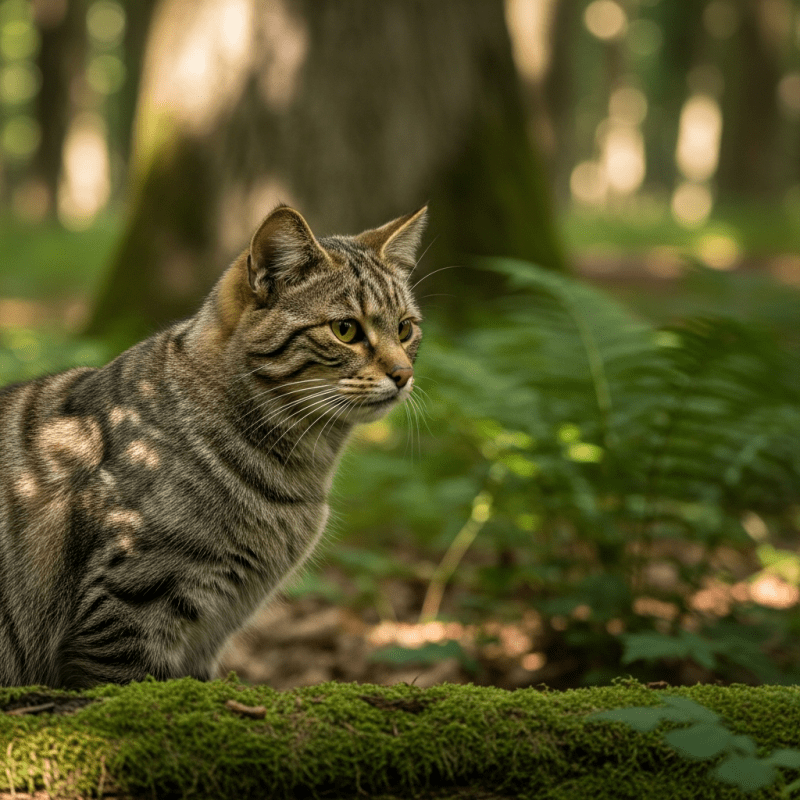
Photorealistic image of a European Wildcat (felines) in its natural habitat
Action shot of a European Wildcat
Close-up macro photograph focusing on the facial features and fur texture of a European Wildcat

Composition & Context

Taxon-Specific Insights

Habitat And Ecology

Preferring deciduous and mixed forests, the European Wildcat thrives in dense woodland, scrubland, and occasionally grasslands. It avoids open agricultural landscapes and urban environments, relying on secluded habitats for hunting and denning. Ecologically, it serves as a keystone predator, controlling small mammal populations and contributing to the health and diversity of forest ecosystems.

🛡️Conservation Status

According to the IUCN Red List, the European Wildcat (Felis silvestris) is classified as Least Concern globally. This status reflects stable or increasing populations in some protected areas, though regional declines are noted where threats are more severe. Conservation status varies locally, with some subspecies and populations facing higher risks.

Threats And Challenges

Major threats to the European Wildcat include habitat loss and fragmentation, road mortality, illegal hunting, and genetic introgression from feral and domestic cats. Hybridization poses a particular challenge, as it can dilute the genetic integrity of wild populations. Conservation efforts focus on habitat protection, population monitoring, and mitigating the impact of domestic cat interbreeding.

🦾Adaptations

The European Wildcat has evolved acute hearing and exceptional night vision, enabling it to hunt efficiently in low-light conditions. Its stealthy movement and cryptic coloration aid in both predation and avoidance of larger predators. These adaptations ensure its survival in diverse and often challenging forest environments.

Reproduction And Lifecycle

Breeding occurs once annually, typically in late winter or early spring. After a gestation period of 56–68 days, females give birth to litters of 2–6 altricial kittens. The young remain with their mother for several months, learning essential survival skills before dispersing to establish their own territories. Parental care is exclusively maternal, with mothers fiercely protective of their offspring.

Breeds And Subspecies

  • Felis silvestris silvestris: The nominate subspecies, widespread across continental Europe.
  • Felis silvestris caucasica: Found in the Caucasus region, adapted to local conditions.
  • Felis silvestris gordoni: Sometimes referred to as the Scottish wildcat, critically endangered and subject to conservation debate.
  • Felis silvestris grampia: Another Scottish population, often considered a distinct subspecies.

Genetic Insights

Genetic research on the European Wildcat includes mitochondrial DNA, microsatellite analysis, and whole-genome sequencing. These studies reveal a close relationship to both the African wildcat and domestic cat, with ongoing investigations into the extent of hybridization. Genetic markers are crucial for distinguishing pure wildcats from hybrids, guiding conservation strategies and informing debates about subspecies boundaries and population integrity.

Faq

  • How can you tell a European Wildcat from a domestic cat?
    The wildcat has a bushier tail with distinct dark rings and a blunt black tip, as well as more robust build and pronounced tabby markings.
  • Are European Wildcats endangered?
    Globally, they are classified as Least Concern, but some regional populations—like the Scottish wildcat—are critically endangered.
  • Do European Wildcats live near humans?
    They generally avoid human settlements, preferring forests and scrublands far from agricultural areas.