Origin Story

The cutter suction dredger concept originated in the late 19th century, evolving from early steam-powered dredging vessels. Its modern form was refined throughout the 20th century, with significant development by European manufacturers such as Royal IHC and Damen Shipyards, alongside American firms like Ellicott Dredges. This evolution reflects advances in hydraulic engineering, vessel design, and automation, guided by standards like ISO 8384:2015.

Classification

Cutter suction dredgers belong to the dredge class of excavators, distinguished by their combined mechanical and hydraulic excavation mechanism. Unlike traditional boom-and-arm excavators, CSDs are stationary or semi-mobile vessels that use a rotating cutter head to disaggregate sediment and powerful suction pumps to transport material hydraulically through pipelines.

Appearance or Form

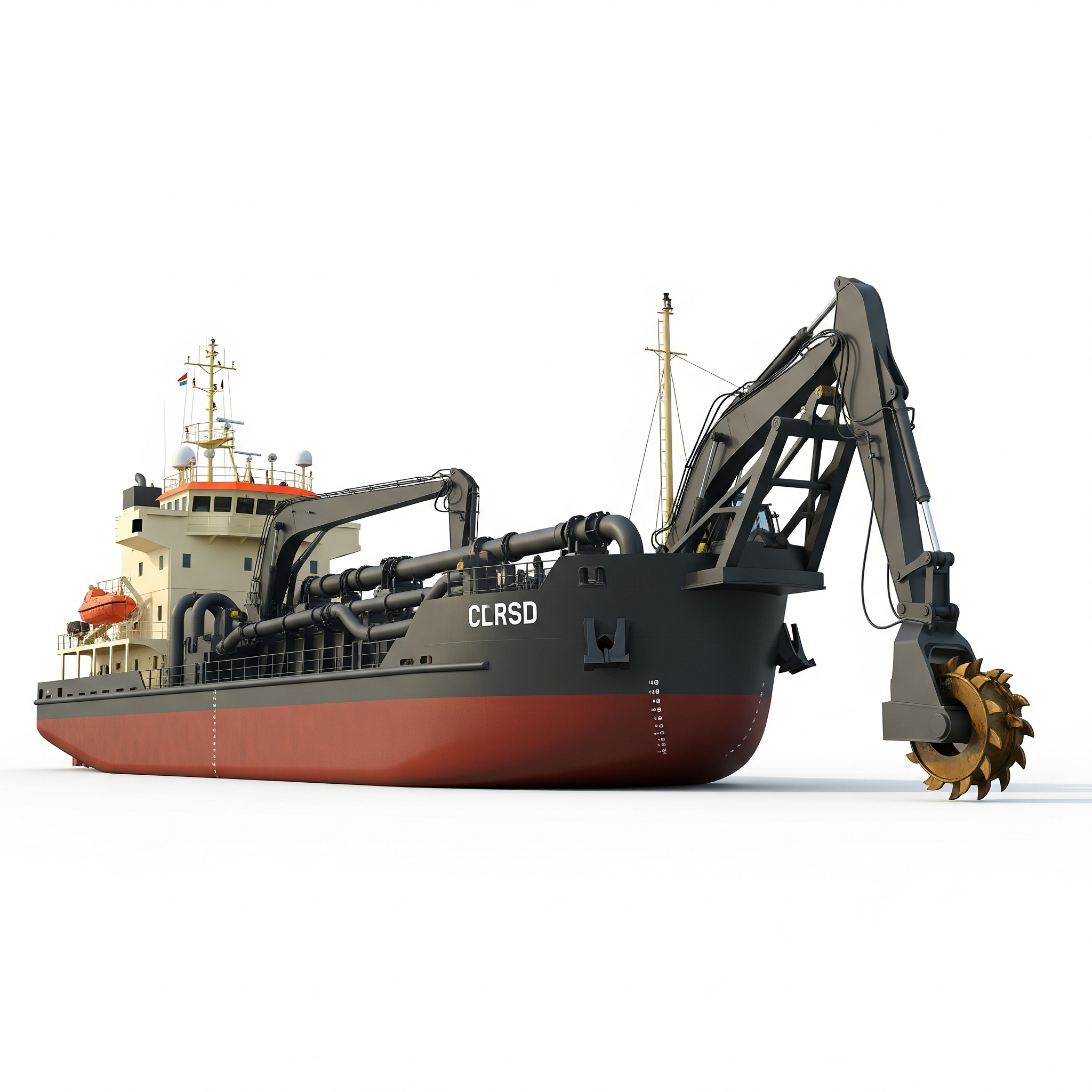
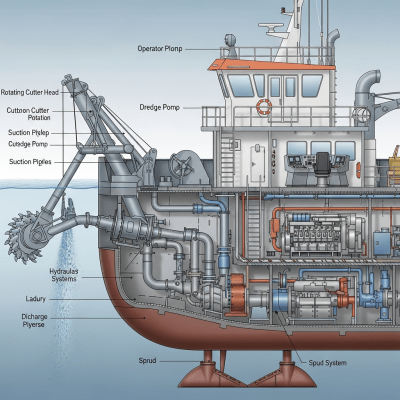
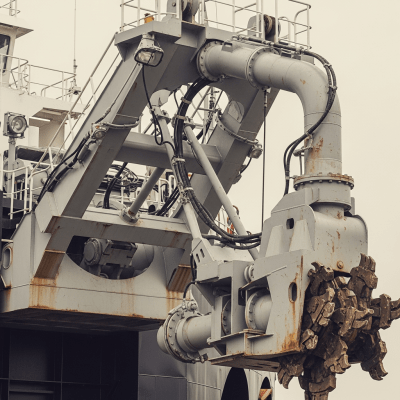
CSDs typically appear as large vessels anchored in place by spud poles and winches. At the bow, a prominent rotating cutter head mounted on a boom breaks up compacted soil or rock underwater. Connected to this is a suction pipeline that carries loosened material through the vessel to discharge points. The overall form is robust and industrial, with auxiliary equipment such as winches and sometimes excavator arms for maintenance.

Behavior or Usage

Cutter suction dredgers operate by mechanically loosening sediment with their cutter head, which is immediately sucked up by high-capacity pumps and transported hydraulically through pipelines to disposal or reclamation sites. They are essential for deepening navigation channels, land reclamation, river maintenance, sand mining, and environmental remediation. While typically stationary during operation, they can reposition by swinging on anchors or limited propulsion.

Merchandise & Prints

Bring this kind into your world � illustrated posters, mugs, and shirts.

Cutter Suction Dredger Cutter Suction Dredger Poster

Cutter Suction Dredger Poster

Archival print, museum-grade paper

Cutter Suction Dredger Cutter Suction Dredger Mug

Cutter Suction Dredger Mug

Stoneware mug, dishwasher safe

Cutter Suction Dredger Cutter Suction Dredger Shirt

Cutter Suction Dredger Shirt

Soft cotton tee, unisex sizes

Attributes & Insights

Taxon-Specific Insights

🌍Cultural Significance

CSDs play a vital role in enabling global maritime trade and urban expansion by maintaining ports and reclaiming land. Their presence is often associated with large-scale engineering feats such as the Palm Islands in Dubai and the Maasvlakte expansion in the Netherlands. Though not prominent in art or myth, they symbolize human mastery over aquatic environments and infrastructure development.

📌Notable Facts

  • CSDs can weigh between 200 and 2,000 metric tonnes, with engine power ranging from 500 to over 15,000 kW.
  • Their cutter heads can operate at powers up to 2,000 kW, enabling excavation of compact soils and rock.
  • Typical dredging depths range from 5 to 35 meters, with some specialized units reaching beyond 50 meters.
  • They comply with stringent maritime safety and emissions standards, including Tier 4 diesel engines and IMO regulations.
  • Modular designs allow disassembly for transport by road or rail, enhancing deployment flexibility.

⚙️Mechanism Details

⚙️ The core excavation mechanism of a cutter suction dredger combines a rotating cutter head with hydraulic suction. The cutter head, mounted on a boom at the vessel’s bow, mechanically disaggregates underwater sediment by rotating and cutting into the soil or rock. Immediately following this, a high-capacity centrifugal pump creates suction that entrains the loosened material into a slurry. This slurry is then transported hydraulically through pipelines—either floating or shore-connected—to disposal or reclamation sites. The system allows continuous excavation and transport, enabling efficient large-scale dredging operations.

Visual Variations

High quality studio photograph of a single Cutter suction dredger (CSD) from the excavators taxonomy
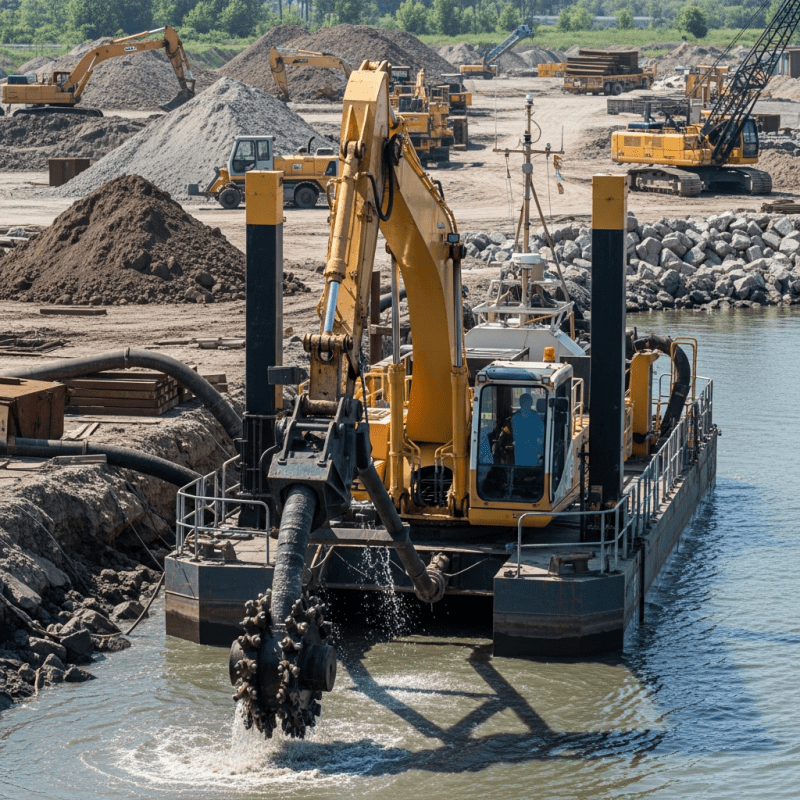
A realistic image of a Cutter suction dredger (CSD) (excavators) at work on a construction site, surrounded by soil, rocks, and machinery
Detailed cross-sectional illustration of a Cutter suction dredger (CSD) from the excavators taxonomy
Image of a diverse group of construction workers operating or interacting with a Cutter suction dredger (CSD) from the excavators taxonomy
A close-up photograph focusing on the bucket and arm of a Cutter suction dredger (CSD) (excavators), showing details such as hydraulic lines, metal textures, and wear marks
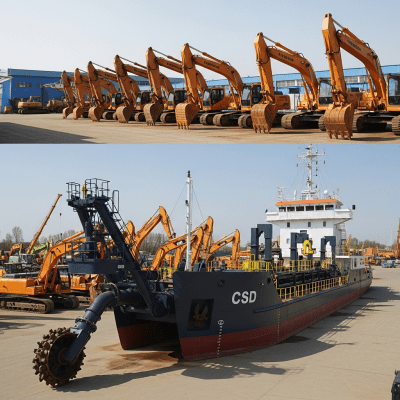
A wide-angle image of a fleet of various excavators, with the specific Cutter suction dredger (CSD) in the foreground for emphasis

Composition & Context

Taxon-Specific Insights

🚜Mobility Types

🚨 Cutter suction dredgers are primarily stationary vessels anchored firmly using spud poles and winches to maintain position during dredging. They can reposition by swinging around their anchors or via auxiliary propulsion systems, but they lack the mobility of land-based excavators. Some modular CSDs can be disassembled and transported by road or rail, allowing relocation between sites. This semi-mobile nature balances operational stability with logistical flexibility.

📏Size And Capacity

📇 CSDs are classified as large excavators, with operating weights ranging from approximately 200,000 to 2,000,000 kilograms. Engine power typically spans 500 to 15,000 kilowatts, reflecting the demands of both propulsion and powerful pumping systems. Cutter head power ranges from 100 to 2,000 kW, enabling excavation of various sediment types. Maximum reach, defined by boom length and swing arc, usually falls between 20 and 40 meters. Bucket capacity is not applicable, as material is transported hydraulically rather than by discrete buckets.

🦺🌿Safety And Emissions

🧪🪔 Cutter suction dredgers adhere to rigorous safety standards including IMO maritime regulations, ISO safety protocols, and local maritime laws. Operator protection includes cab safety features and hazard awareness for rotating machinery and high-pressure pipelines. Vessel stability is continuously monitored to prevent capsizing risks. Emissions compliance typically meets Tier 4 diesel engine standards, with increasing adoption of electric drives for pumps and auxiliaries to reduce environmental impact.

🔧Attachments And Accessories

🛠 Common attachments and accessories for CSDs include:

  • Cutter heads: Various designs tailored for soil, clay, or rock excavation.
  • Suction pipelines: Flexible or rigid conduits for slurry transport.
  • Discharge pipelines: Deliver excavated material to shore or reclamation sites.
  • Spud poles and winches: For anchoring and positioning the vessel.
  • Auxiliary excavator arms: Used for maintenance and clearing obstructions.

🛠️⏳Maintenance And Lifecycle

🛠️⏳ Cutter suction dredgers are engineered for multi-decade service lives, with maintenance focused on regular overhauls of pumps, cutter heads, and hull structures. The abrasive nature of slurry and underwater operation subjects components to wear and corrosion, necessitating scheduled inspections and replacements. Lifecycle management includes corrosion protection, hydraulic system servicing, and periodic modernization to maintain efficiency and regulatory compliance.

Faq

Q: What distinguishes a cutter suction dredger from other dredgers?
A: Unlike trailing suction hopper dredgers that collect sediment in onboard hoppers, CSDs mechanically cut and hydraulically pump sediment through pipelines without onboard storage.

Q: Are cutter suction dredgers mobile?
A: They are generally stationary during operation, anchored in place, but can reposition by swinging on anchors or limited propulsion.

Q: What types of sediment can CSDs handle?
A: Their rotating cutter heads can handle compacted soil, clay, and even some rock types, making them versatile for various dredging tasks.