Origin Story

The amphibious excavator concept emerged in the late 20th century, primarily developed in Japan and Southeast Asia to address the challenges of wetland reclamation, flood control, and environmental restoration. Early manufacturers adapted standard hydraulic excavators by mounting them on sealed, floating pontoons, with commercial models appearing in the 1980s. Since then, designs have evolved to improve stability, corrosion resistance, and operational reach in aquatic settings.

Classification

Amphibious pontoon excavators belong to the hydraulic excavator family, distinguished by their pontoon-based mobility system. They are classified as large hydraulic excavators equipped for aquatic and semi-aquatic applications, bridging the gap between traditional land-based excavators and specialized dredging equipment.

Appearance or Form

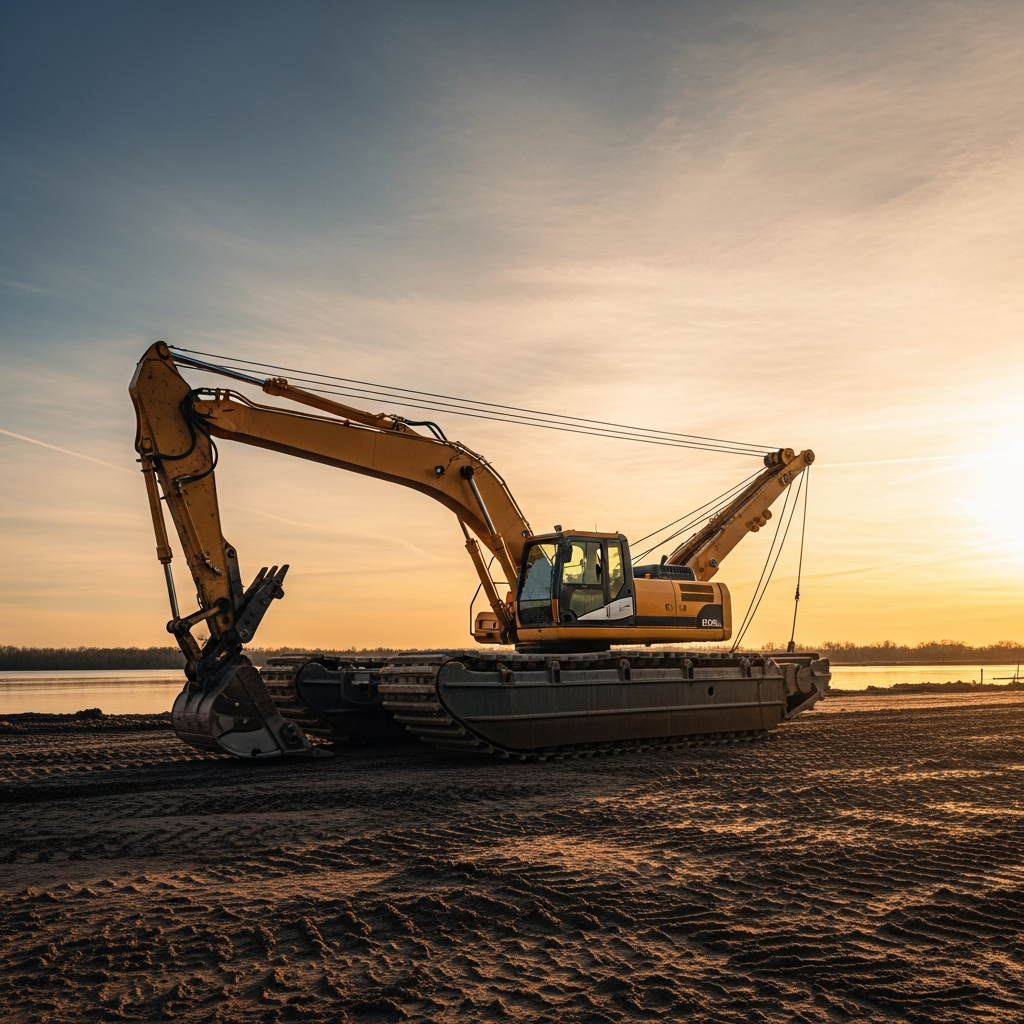
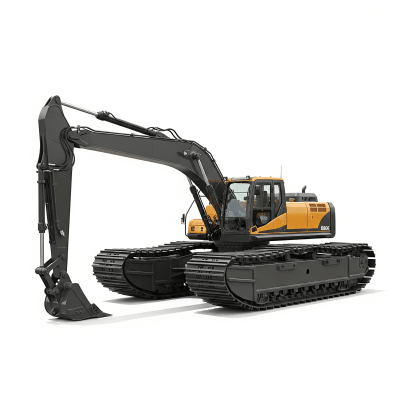
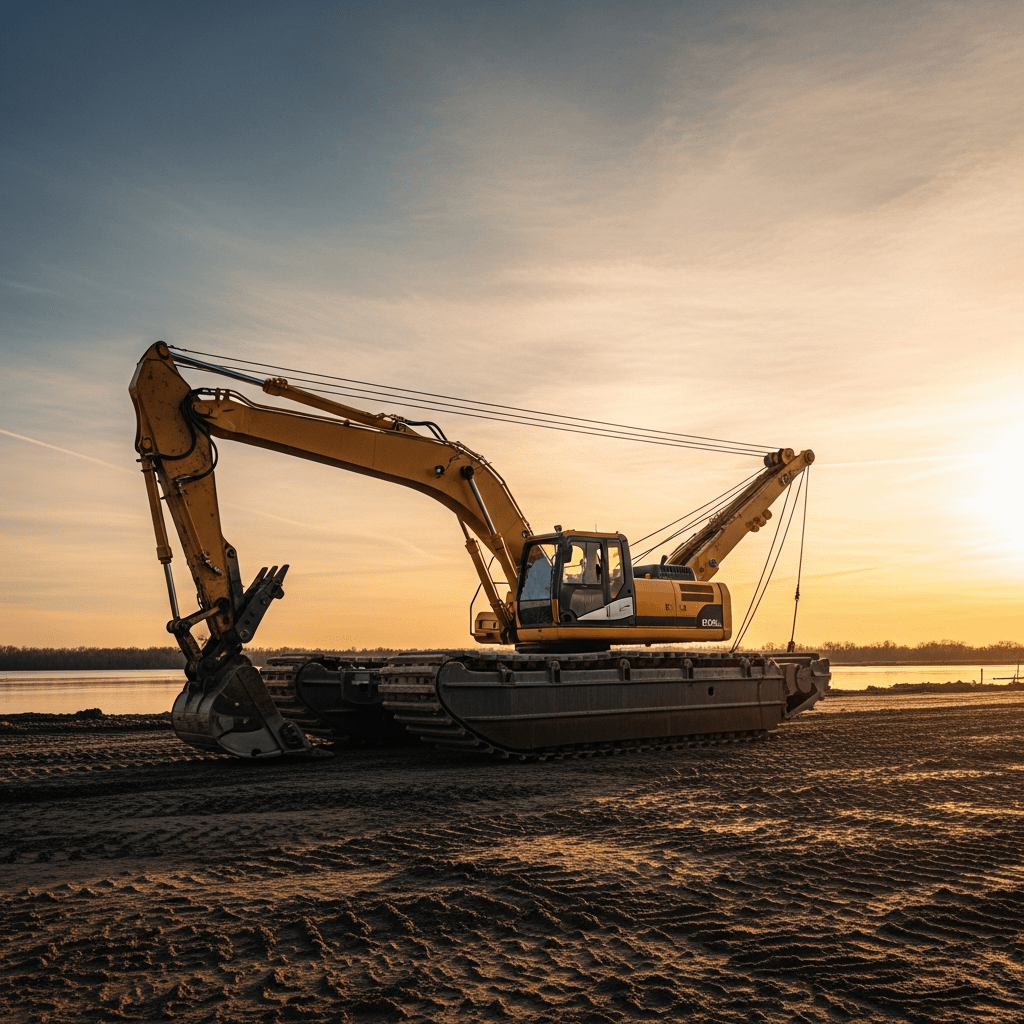
These excavators feature a standard hydraulic upper structure mounted atop one or more sealed, buoyant pontoons that provide flotation. The pontoons may be fixed or extendable for added stability. Visually, they resemble conventional excavators but with wide, flat, boat-like undercarriages designed to distribute weight over soft or submerged terrain. The operator cab is reinforced and elevated to enhance visibility and safety in wet environments.

Behavior or Usage

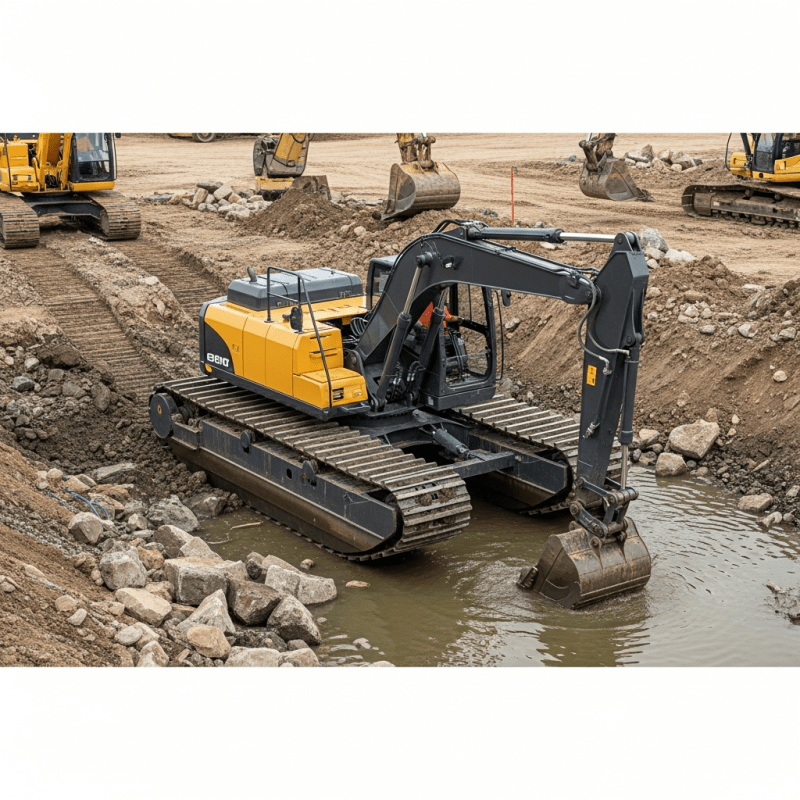
Amphibious pontoon excavators perform earthmoving and dredging tasks in wetlands, marshes, shallow lakes, and flood-prone areas. Their buoyant undercarriage allows them to traverse waterlogged soils and shallow waters, enabling activities such as dredging sediment, restoring wetlands, constructing levees, and environmental remediation. They are essential in regions where conventional crawler or wheeled excavators cannot safely operate.

Merchandise & Prints

Bring this kind into your world � illustrated posters, mugs, and shirts.

Amphibious pontoon excavator Amphibious pontoon excavator Poster

Amphibious pontoon excavator Poster

Archival print, museum-grade paper

Amphibious pontoon excavator Amphibious pontoon excavator Mug

Amphibious pontoon excavator Mug

Stoneware mug, dishwasher safe

Amphibious pontoon excavator Amphibious pontoon excavator Shirt

Amphibious pontoon excavator Shirt

Soft cotton tee, unisex sizes

Attributes & Insights

Taxon-Specific Insights

🌍Cultural Significance

While primarily functional, amphibious excavators have gained recognition in environmental engineering and civil infrastructure projects, symbolizing human ingenuity in adapting heavy machinery to delicate ecosystems. They appear in modern engineering showcases and environmental restoration narratives, highlighting sustainable approaches to managing wetlands and flood control.

📌Notable Facts

  • Amphibious excavators can operate safely on soft, waterlogged terrain where standard excavators would become immobilized.
  • They often feature zero or reduced tail swing to prevent collisions with pontoons during operation.
  • Typical bucket capacities range from 0.5 to 2.5 cubic meters, with long-reach booms extending up to 22 meters.
  • Some models include emergency flotation devices and anti-corrosion coatings to withstand harsh aquatic environments.
  • They are transported in modular sections and assembled on-site due to their size and specialized undercarriage.

⚙️Mechanism Details

⚙️ Amphibious pontoon excavators use articulated booms and arms actuated by hydraulic cylinders to perform excavation. The hydraulic system powers the boom, stick, and bucket movements, providing precise control and strong breakout forces. The pontoon undercarriage supports the upper structure and allows flotation, often incorporating extendable side pontoons for stability. Hydraulic pumps driven by diesel engines supply fluid power, while the operator controls excavation and positioning from a reinforced cab designed to withstand aquatic conditions.

Visual Variations

High quality studio photograph of a single Amphibious / pontoon excavator from the excavators taxonomy
A realistic image of a Amphibious / pontoon excavator (excavators) at work on a construction site, surrounded by soil, rocks, and machinery
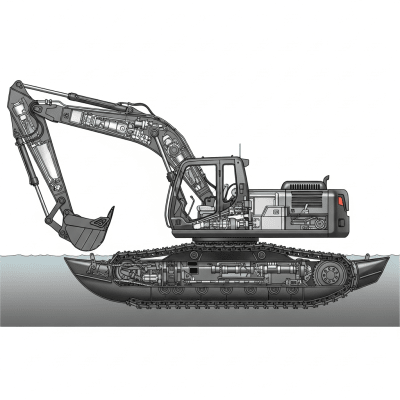
Detailed cross-sectional illustration of a Amphibious / pontoon excavator from the excavators taxonomy
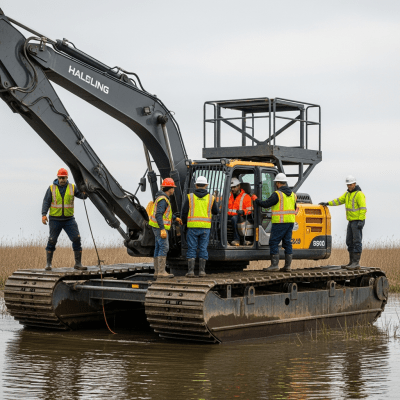
Image of a diverse group of construction workers operating or interacting with a Amphibious / pontoon excavator from the excavators taxonomy
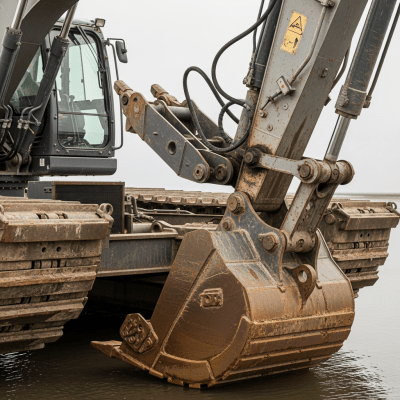
A close-up photograph focusing on the bucket and arm of a Amphibious / pontoon excavator (excavators), showing details such as hydraulic lines, metal textures, and wear marks
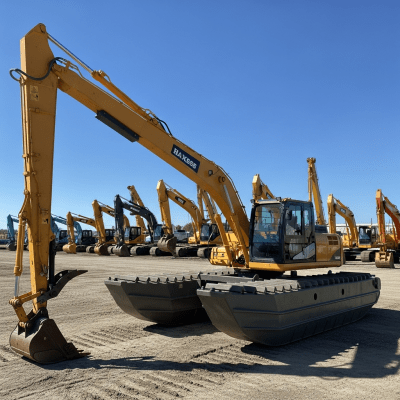
A wide-angle image of a fleet of various excavators, with the specific Amphibious / pontoon excavator in the foreground for emphasis

Composition & Context

Taxon-Specific Insights

🚜Mobility Types

🚨 Mobility in amphibious excavators is provided by pontoon undercarriages—sealed, buoyant structures that enable flotation and movement over water and soft ground. Some models feature extendable or retractable side pontoons to increase stability during operation. Unlike crawler or wheeled excavators, pontoon excavators can traverse shallow water and marshy terrain without sinking or becoming stuck, making them uniquely suited for aquatic environments.

📏Size And Capacity

📇 Amphibious pontoon excavators typically fall into the large size class, with operating weights ranging from 20,000 to 60,000 kilograms. Engine power commonly spans 100 to 300 kilowatts. Bucket capacities vary between 0.5 and 2.5 cubic meters, accommodating a range of dredging and earthmoving tasks. Maximum reach extends from 12 to 22 meters, often utilizing long-reach booms to access submerged or distant work areas.

🦺🌿Safety And Emissions

🛡️ Safety features include reinforced operator cabs with rollover protection, emergency flotation devices to prevent capsizing, anti-corrosion coatings to withstand aquatic environments, and enhanced visibility systems for safe operation. Emissions compliance typically meets Tier 4 standards, reflecting modern diesel engine regulations. Stability is a critical design consideration, with ballast systems and pontoon geometry engineered to minimize risk of tipping or sinking.

🔧Attachments And Accessories

🛠️ Common attachments for amphibious excavators include dredging buckets for sediment removal, clamshell buckets for grabbing materials, long-reach booms for extended access, rakes for debris clearing, hydraulic cutters for vegetation or roots, suction hoses for slurry removal, and pile drivers for foundation work. These versatile tools enable the machine to adapt to diverse aquatic excavation and environmental management tasks.

🛠️⏳Maintenance And Lifecycle

🛠️️⏳ Maintenance of amphibious excavators demands special attention due to constant exposure to water, silt, and corrosive elements. Hydraulic components require frequent inspection and servicing to prevent leaks and wear. Pontoon integrity must be regularly checked for corrosion and sealing effectiveness. Service intervals are generally shorter than for land-based excavators, and operators must follow rigorous routines to ensure longevity. Typical service life ranges depend on usage intensity but often span 10 to 15 years with proper care.

Faq

Q: What environments are amphibious excavators best suited for?
They excel in wetlands, marshes, shallow lakes, and flood-prone areas where ground conditions prevent use of conventional excavators.

Q: How do amphibious excavators stay afloat?
They use sealed, buoyant pontoons that distribute weight and provide flotation over soft or submerged terrain.

Q: Are amphibious excavators operated remotely?
Most are manned, but remote and autonomous variants are emerging for hazardous or sensitive environments.