
Velum
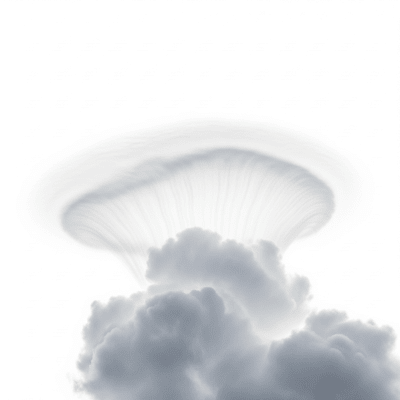
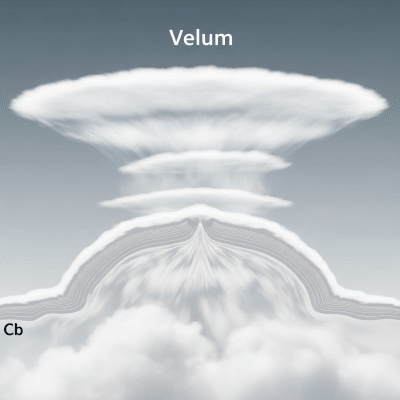
Velum is a thin, horizontal veil-like accessory cloud that partially envelops or skirts the upper portion of a parent cloud, typically a towering Cumulonimbus or large Cumulus.
Velum is a thin, horizontal veil-like accessory cloud that partially envelops or skirts the upper portion of a parent cloud, typically a towering Cumulonimbus or large Cumulus.
The term "velum" originates from the Latin word for "veil," aptly describing its delicate, sheet-like appearance. Although formally recognized as an accessory cloud feature in the 2017 World Meteorological Organization International Cloud Atlas, its visual and conceptual roots trace back to early 19th-century cloud classification by Luke Howard. Velum is never a standalone cloud but always forms in association with a mother cloud such as Cumulonimbus or Cumulus congestus.
Velum is classified as an accessory cloud feature rather than a genus or species. It is always attached to or surrounds the upper part of a parent cloud, most commonly Cumulonimbus or large Cumulus congestus. This classification places velum within the vertical cloud family, reflecting its dependence on the altitude and development stage of its mother cloud.
Velum appears as a smooth, thin, and often semi-transparent horizontal sheet or veil. Its color ranges from grayish to whitish, and it typically forms a skirt-like layer enveloping or extending beyond the upper regions of the parent cloud. This delicate cloud layer is visually distinct for its smooth texture and horizontal spread, contrasting with the towering, textured form of the underlying convective cloud.
Velum forms during the mature or growing phase of its parent cloud, created as moist air is lifted and condensed at the cloud’s upper levels. The resulting thin veil is advected horizontally by winds, often spreading out from the rapidly developing convective core. While velum itself does not produce precipitation or pose hazards, its presence signals vigorous vertical growth in the parent cloud and is a useful indicator for meteorologists and cloud spotters monitoring convective activity.
Bring this kind into your world illustrated posters, mugs, and shirts.

Archival print, museum-grade paper
Buy Poster
Stoneware mug, dishwasher safe
Buy Mug
Soft cotton tee, unisex sizes
Buy ShirtThough less prominent than other cloud features in art or folklore, velum occasionally appears in photographic and artistic depictions of dramatic skies, appreciated for its delicate veil-like form. It is referenced in cloud identification guides and meteorological education as a distinctive accessory cloud, symbolizing the dynamic evolution of towering storm clouds.
Velum forms when moist air near the upper levels of a rapidly growing convective cloud is lifted and cooled to its condensation point, creating a thin, horizontal layer of cloud droplets. This layer spreads laterally as it is advected by winds, often appearing as a smooth veil or skirt around the parent cloud’s upper portion. The process reflects the dynamic outflow and expansion of cloud material from vigorous updrafts within the mother cloud, typically during its mature or growing phase.


Velum occurs within the vertical extent of its parent cloud, generally between 1,000 and 8,000 meters above ground level. Its presence is most common in temperate and tropical regions where large Cumulonimbus or Cumulus congestus clouds develop during convective weather events. The altitude varies depending on the mother cloud’s height, but velum consistently forms near the upper portions of these towering clouds.
Velum itself poses no direct hazards or safety concerns, as it does not produce precipitation or severe weather. However, since it is attached to vigorous convective clouds like Cumulonimbus, any hazards such as turbulence, lightning, or heavy precipitation originate from the parent cloud, not the velum feature.
Velum is primarily observed visually from the ground and documented through photography due to its delicate and thin nature. Remote sensing techniques such as satellite imagery have limited capability to detect velum because of its thinness and lack of distinct radiative signatures. Observers rely on direct visual identification, often noting its veil-like appearance enveloping the upper parts of towering clouds.
In satellite imagery, velum is generally too thin and small-scale to be distinctly resolved. When visible, it may appear as a faint, smooth horizontal extension or veil around the brighter, more textured core of a parent Cumulonimbus or Cumulus cloud in high-resolution visible bands. Infrared and other spectral channels typically do not highlight velum due to its limited optical thickness and small spatial extent.