
Common Starling
The Common Starling (Sturnus vulgaris) is a medium-sized songbird renowned for its iridescent plumage, complex vocal mimicry, and remarkable adaptability to urban and rural landscapes.
The Common Starling (Sturnus vulgaris) is a medium-sized songbird renowned for its iridescent plumage, complex vocal mimicry, and remarkable adaptability to urban and rural landscapes.
First described by Carl Linnaeus in 1758, the Common Starling originated across Europe, Asia, and North Africa. Its global spread is largely due to deliberate introductions for pest control and aesthetic purposes, with populations now thriving in North America, Australia, New Zealand, and South Africa. These introductions have shaped its reputation as both a cosmopolitan species and a symbol of avian adaptability.
The Common Starling belongs to the order Passeriformes, family Sturnidae, and genus Sturnus. As a member of the class Aves, it shares the defining bird traits of feathers, beaks, and egg-laying reproduction. Its close relatives include other starlings and mynas, all known for social behaviors and vocal complexity.
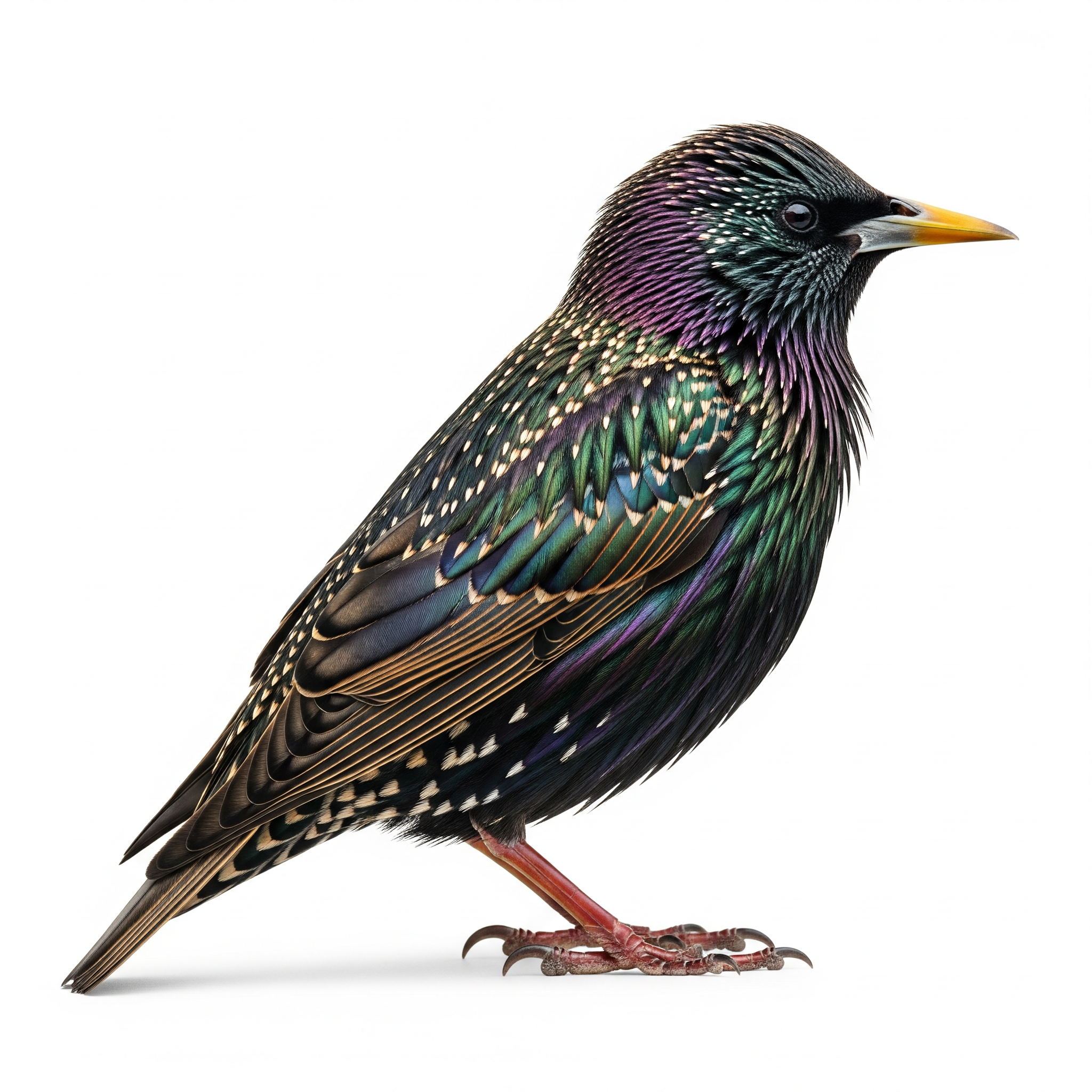
Measuring about 19–23 cm in length with a wingspan of 31–44 cm, the Common Starling is instantly recognizable by its glossy black plumage, which shimmers with metallic greens and purples in sunlight. White spots dot its feathers in winter, while its bill shifts from yellow in breeding season to dark in colder months. Its compact body, short tail, and pointed wings give it a streamlined silhouette, especially striking during synchronized flock flights.
Common Starlings are highly social, forming vast flocks that perform mesmerizing aerial displays known as murmurations. Their vocal repertoire is rich, featuring whistles, clicks, and extraordinary mimicry of other birds and environmental sounds. As cavity nesters, they compete aggressively for nesting sites, often displacing native species. Their adaptability allows them to thrive in cities, farms, and woodlands, making them a frequent subject of ornithological study and wildlife observation.
Bring this kind into your world illustrated posters, mugs, and shirts.
Archival print, museum-grade paper
Buy Poster
Stoneware mug, dishwasher safe
Buy Mug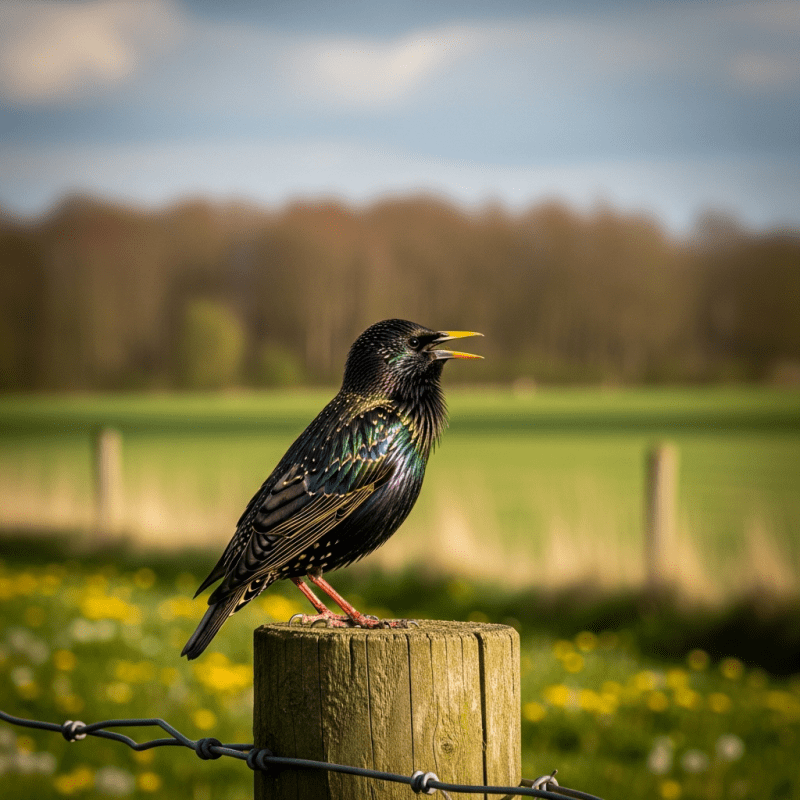
Soft cotton tee, unisex sizes
Buy ShirtThroughout history, the Common Starling has appeared in art, literature, and folklore, often admired for its dazzling murmurations and vocal mimicry. In some cultures, starlings symbolize adaptability and communal strength. Their introduction into North America is famously linked to a Shakespeare enthusiast who sought to bring every bird mentioned in the Bard’s works to the continent, cementing the starling’s place in cultural narratives.
Originally native to Europe, Asia, and North Africa, the Common Starling now inhabits urban centers, farmland, and open woodlands across much of the world. Its adaptability has enabled it to establish thriving populations in North America, Australia, New Zealand, and South Africa, making it one of the most widely distributed birds on the planet.

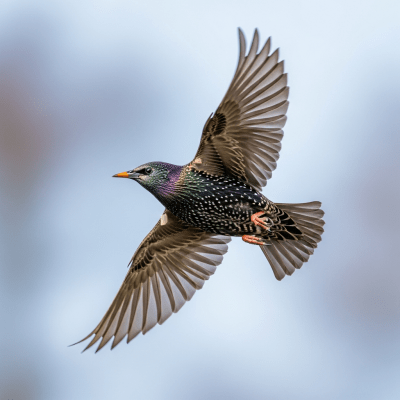
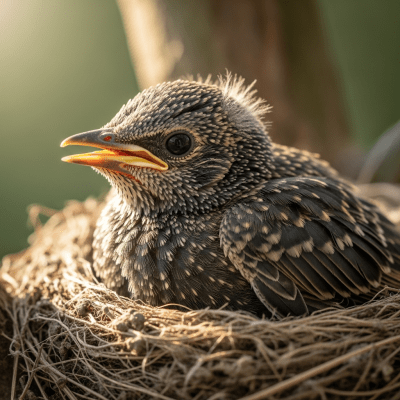
Omnivorous by nature, Common Starlings feed on insects, fruits, seeds, and even human refuse. Their pointed bills allow them to probe soil and vegetation for invertebrates, while their opportunistic feeding habits help them exploit a wide range of food sources in both natural and urban environments.
Common Starlings are cavity nesters, often utilizing tree holes, buildings, or nest boxes. They breed in spring, with pairs aggressively defending nesting sites. Clutch sizes and detailed breeding frequencies vary regionally, but starlings are known for their adaptability and competitive nesting behavior. Lifespan in the wild typically ranges from several years, with many birds surviving multiple breeding seasons.
The Common Starling is classified as a species of "Least Concern" globally due to its vast population and broad distribution. However, in some regions, populations have declined due to habitat changes and competition, while in others, they are considered invasive and problematic for native wildlife and agriculture.
Economically, the Common Starling is both a pest—causing crop damage and competing with native species—and a valuable research subject for ornithologists. Ecologically, its presence influences insect populations, seed dispersal, and nesting site competition. Its adaptability and flocking behavior also make it a key species for studies of social dynamics and urban ecology.
While not domesticated in the traditional sense, Common Starlings are kept in aviculture for their vocal abilities and captivating behaviors. Authorities recognize several subspecies, including S. v. vulgaris (nominate), S. v. faroensis (Faroe Islands), and S. v. zetlandicus (Shetland Islands), reflecting regional adaptations in plumage and vocalization.
Common Starling is also known as European Starling and simply Starling. Regional names may vary, but Sturnus vulgaris remains the accepted scientific name. These synonyms reflect its widespread presence and recognition across continents.