Origin Story

Spanish Colonial Revival originated in the early 20th century, gaining momentum after the 1915 Panama-California Exposition in San Diego, which celebrated the region’s Spanish heritage. Architects and designers in California, Florida, and the American Southwest drew inspiration from the colonial architecture of Spain and Latin America, adapting its picturesque forms to new civic, residential, and institutional buildings. The style flourished between 1915 and 1940, reflecting both nostalgia for the past and a desire to forge a distinctive regional identity.

Classification

Spanish Colonial Revival belongs to the broader Revivalism school of architecture, which sought to reinterpret historic styles for modern contexts. Within this movement, it is recognized as a distinct style, with several regional substyles such as California and Florida Spanish Colonial Revival. Its lineage traces back to original Spanish Colonial architecture, but it stands apart for its eclectic blending of Mediterranean, Moorish, and Baroque influences.

Appearance or Form

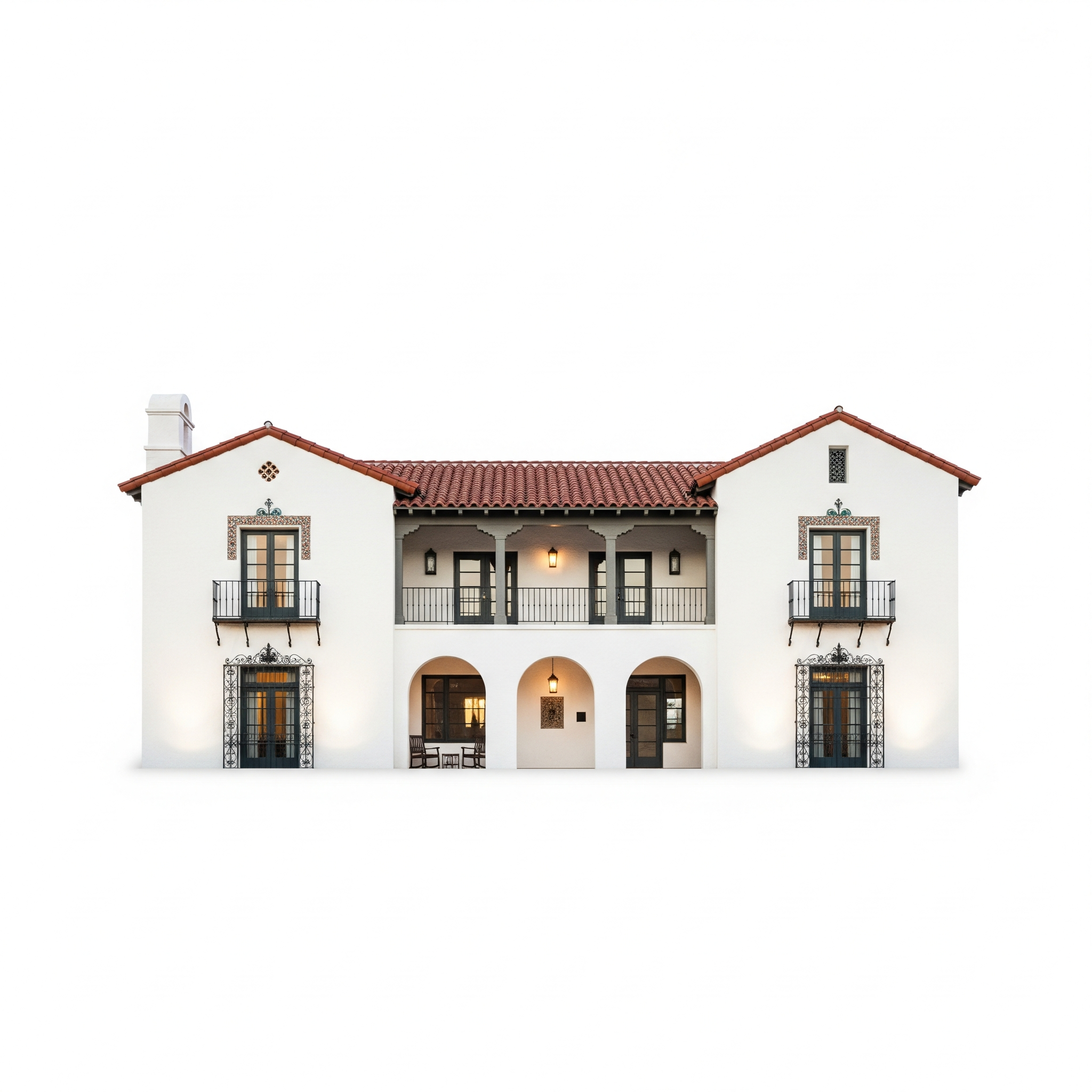
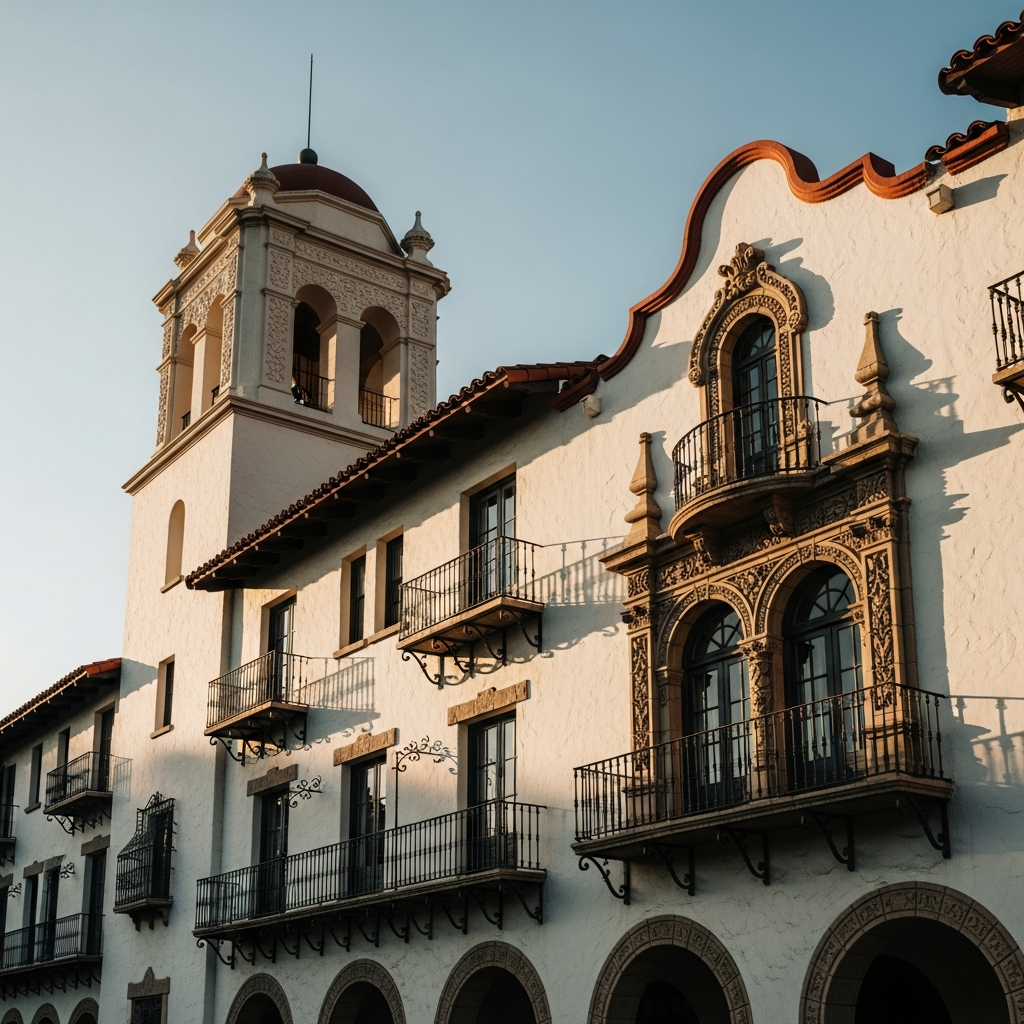
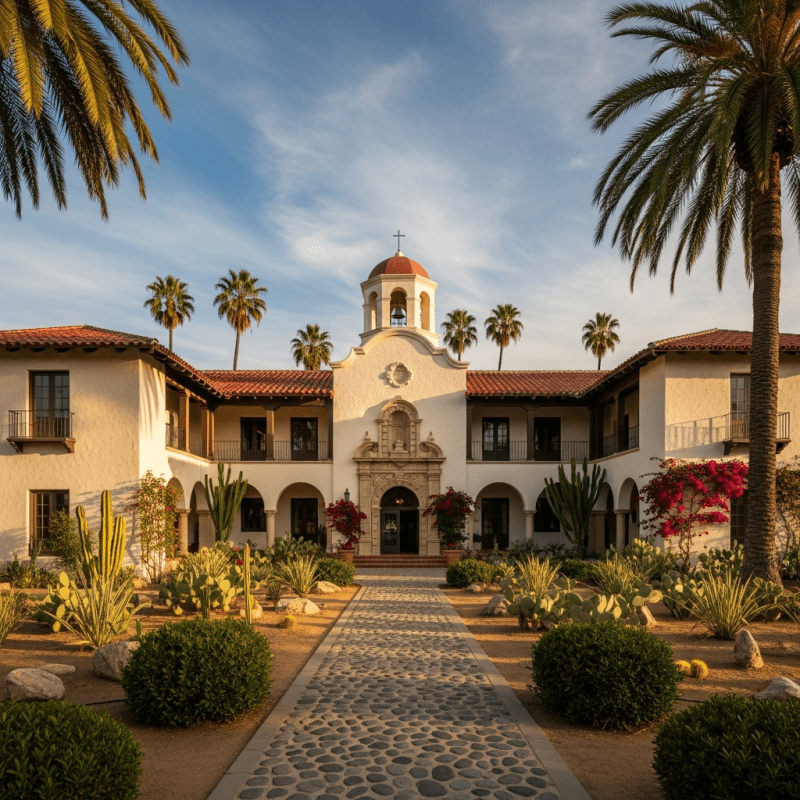
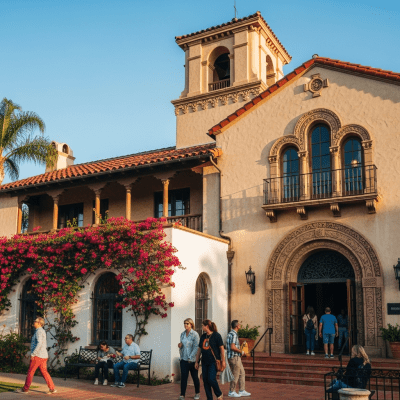
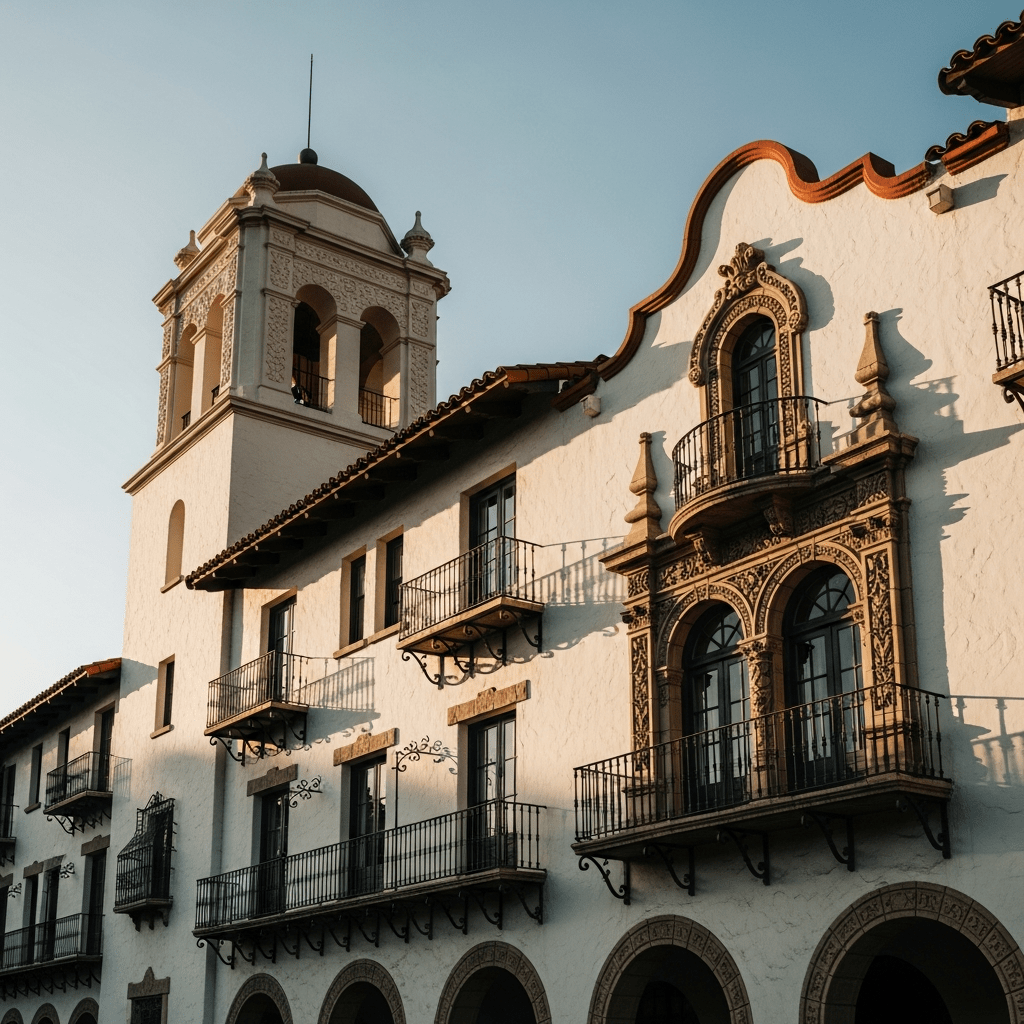
The style is instantly recognizable by its white or light-colored stucco walls, low-pitched red clay tile roofs, and asymmetrical facades. Arched corridors, arcades, and windows create a sense of openness, while wrought iron grilles, decorative tilework, and carved wooden doors add intricate detail. Courtyards and patios are central, often lushly landscaped and framed by arcades. Interiors feature exposed wooden beams, ornamental plasterwork, and vibrant ceramic tiles, evoking warmth and craftsmanship. The overall effect is both romantic and picturesque, blending indoor and outdoor spaces seamlessly.

Behavior or Usage

Spanish Colonial Revival architecture is highly versatile, serving as the design language for residential villas, hotels, civic buildings, and educational institutions. Its layout encourages interaction with the outdoors, with courtyards and patios acting as social hubs. The style’s ornamental features and inviting forms make it popular for public and private spaces alike, contributing to a sense of place and identity in regions where it is prevalent.

Merchandise & Prints

Bring this kind into your world � illustrated posters, mugs, and shirts.

Spanish Colonial Revival Spanish Colonial Revival Poster

Spanish Colonial Revival Poster

Archival print, museum-grade paper

Spanish Colonial Revival Spanish Colonial Revival Mug

Spanish Colonial Revival Mug

Stoneware mug, dishwasher safe

Spanish Colonial Revival Spanish Colonial Revival Shirt

Spanish Colonial Revival Shirt

Soft cotton tee, unisex sizes

Attributes & Insights

Taxon-Specific Insights

🌍Cultural Significance

This style is deeply woven into the cultural fabric of California, Florida, and the American Southwest, symbolizing a romanticized connection to Spanish and colonial heritage. It has shaped the visual identity of cities such as Santa Barbara and Coral Gables, and is celebrated in art, literature, and tourism. Spanish Colonial Revival is often associated with regional pride and nostalgia, and its enduring popularity reflects a broader appreciation for craftsmanship and historical continuity in American architecture.

📌Notable Facts

  • Spanish Colonial Revival was popularized by the 1915 Panama-California Exposition, which showcased its aesthetic to a wide audience.
  • Many iconic Hollywood homes and resorts were built in this style, contributing to its glamorous reputation.
  • The Santa Barbara County Courthouse is considered one of the finest examples, and is a designated National Historic Landmark.
  • Some Spanish Colonial Revival buildings incorporate elements from Moorish and Mexican traditions, creating a rich architectural fusion.
  • The style’s influence extends to modern suburban developments and resort architecture throughout the Sun Belt.

🗺️Period And Region

Spanish Colonial Revival flourished from approximately 1915 to 1940, with continued influence into the mid-20th century. Its origins are rooted in the United States—most notably California, Florida, Texas, and Arizona—where it reinterpreted colonial forms for new civic and residential needs. The style’s reach expanded across the American Southwest and into resort communities nationwide.

Visual Variations

High quality, studio-style photograph of a single Spanish Colonial Revival from the architecture taxonomy
A wide-angle photograph of Spanish Colonial Revival, a type of architecture, situated in its typical environment or setting
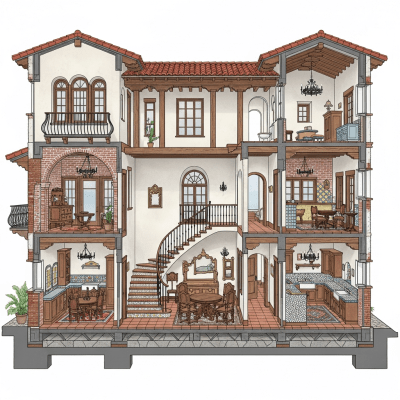
Detailed cross-sectional illustration or cutaway view showing the internal layout and key structural elements of the Spanish Colonial Revival (architecture)
Photograph depicting Spanish Colonial Revival, an example of architecture, in active use or cultural context—such as being inhabited, visited, or used for its intended purpose—while keeping focus on the structure itself
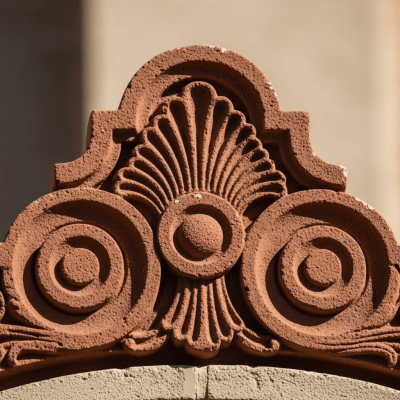
Close-up detail shot of a distinctive feature or ornamentation from the Spanish Colonial Revival (architecture), showing material texture, craftsmanship, or unique design elements

Composition & Context

Taxon-Specific Insights

✨Key Characteristics

  • White or light-colored stucco walls
  • Low-pitched red clay tile roofs
  • Asymmetrical facades and arched corridors
  • Arcades, wrought iron grilles, and decorative tilework
  • Carved wooden doors and exposed beams
  • Courtyards and patios integrated into the layout
  • Ornamental plasterwork and colorful ceramic tiles
  • Romantic, picturesque aesthetic with Mediterranean influences

🧱Materials And Techniques

Typical materials include stucco, red clay tiles, masonry, timber, wrought iron, ceramic tiles, and carved wood. Construction techniques emphasize masonry and timber framing, with ornamental detailing and the integration of courtyards and patios. Local materials are often used to reinforce regional identity, and craftsmanship is celebrated in both structural and decorative elements.

🏛️Notable Works

  • The Mission Inn, Riverside, California
  • Santa Barbara County Courthouse, California
  • Beverly Hills City Hall, California
  • Coral Gables City Hall, Florida
  • El Prado Complex, Balboa Park, San Diego

👷‍♂️Notable Practitioners

  • Bertram Goodhue
  • Wallace Neff
  • George Washington Smith
  • Arthur B. Benton
  • Julia Morgan

🔗Influences And Related Styles

Spanish Colonial Revival draws direct inspiration from the Spanish Colonial architecture of the Americas, as well as Mission Revival, Moorish, Baroque, and Mexican Colonial traditions. It is closely related to Mediterranean Revival, Pueblo Revival, and Mission Revival, and has hybridized with Art Deco and Moderne styles in certain contexts, reflecting a dynamic blend of historic and modern influences.

🌍Regional Variants

Distinct regional variants include California Spanish Colonial Revival, which emphasizes lush courtyards and ornate detailing; Florida Spanish Colonial Revival, often featuring more tropical landscaping and lighter color palettes; and Southwest adaptations that integrate Pueblo and Mexican influences. Mediterranean Revival and Mission Revival are sometimes grouped as related or overlapping styles, but each maintains unique characteristics within the broader revivalist tradition.

🏅Heritage And Recognition

Many Spanish Colonial Revival buildings are recognized as historic landmarks, with listings on the U.S. National Register of Historic Places and designation by local heritage organizations. The Santa Barbara County Courthouse and El Prado Complex in Balboa Park are National Historic Landmarks, and the style is referenced in UNESCO World Heritage documentation for its role in shaping regional identity and architectural heritage in the United States.

Faq

  • What are the main features of Spanish Colonial Revival architecture?
    White stucco walls, red clay tile roofs, arched openings, courtyards, and ornate tilework are hallmarks of the style.
  • Where is Spanish Colonial Revival most commonly found?
    It is especially prevalent in California, Florida, Texas, Arizona, and the broader American Southwest.
  • How does Spanish Colonial Revival differ from Mission Revival?
    While both draw from Spanish Colonial precedents, Spanish Colonial Revival is more ornate and eclectic, incorporating Mediterranean and Baroque influences, whereas Mission Revival is simpler and inspired by early California missions.