
Neoclassical
Neoclassical architecture is a style rooted in the revival of classical Greek and Roman forms, celebrated for its symmetry, grandeur, and enduring influence on public and monumental buildings worldwide.
Neoclassical architecture is a style rooted in the revival of classical Greek and Roman forms, celebrated for its symmetry, grandeur, and enduring influence on public and monumental buildings worldwide.
Neoclassical architecture emerged in mid-18th century Europe, particularly in France, Britain, and Italy, as a reaction against the ornate Baroque and Rococo styles. Sparked by archaeological discoveries at sites like Herculaneum and Pompeii and inspired by Enlightenment ideals, architects sought to revive the rationality and civic virtue of ancient Greece and Rome. The movement quickly spread across Europe and the Americas, shaping the built environment well into the 19th century and beyond.
Neoclassical is a distinct style within the Western Classical Tradition of architecture. It sits alongside related movements such as Palladianism and Renaissance Classicism, and encompasses several substyles including Greek Revival, Federal, Empire, and Regency. Its classification is defined by its deliberate reference to antiquity and its role as a counterpoint to the exuberance of Baroque and Rococo.
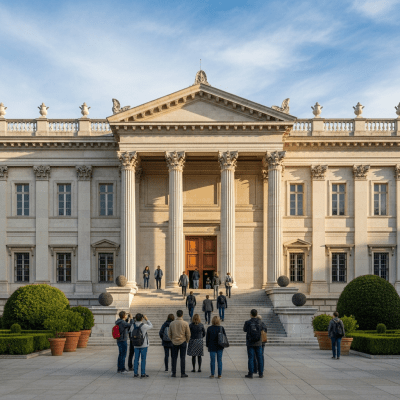
Neoclassical buildings are instantly recognizable for their balanced, symmetrical facades, grand columns in Doric, Ionic, or Corinthian orders, and imposing porticos. Triangular pediments, domes, and blank walls with restrained ornamentation evoke the solemnity of ancient temples. Decorative elements such as pilasters, entablatures, friezes, and swags are used sparingly, creating a sense of dignity and clarity. The overall effect is one of order, proportion, and timeless elegance.
Neoclassical architecture has long been favored for civic and institutional buildings, symbolizing stability, democracy, and cultural refinement. It is commonly found in government edifices, museums, banks, courthouses, educational institutions, private mansions, and monuments. The style’s rational layout and monumental scale invite public engagement and convey authority, making it a preferred choice for spaces intended to inspire and educate.
Bring this kind into your world illustrated posters, mugs, and shirts.

Archival print, museum-grade paper
Buy Poster
Stoneware mug, dishwasher safe
Buy Mug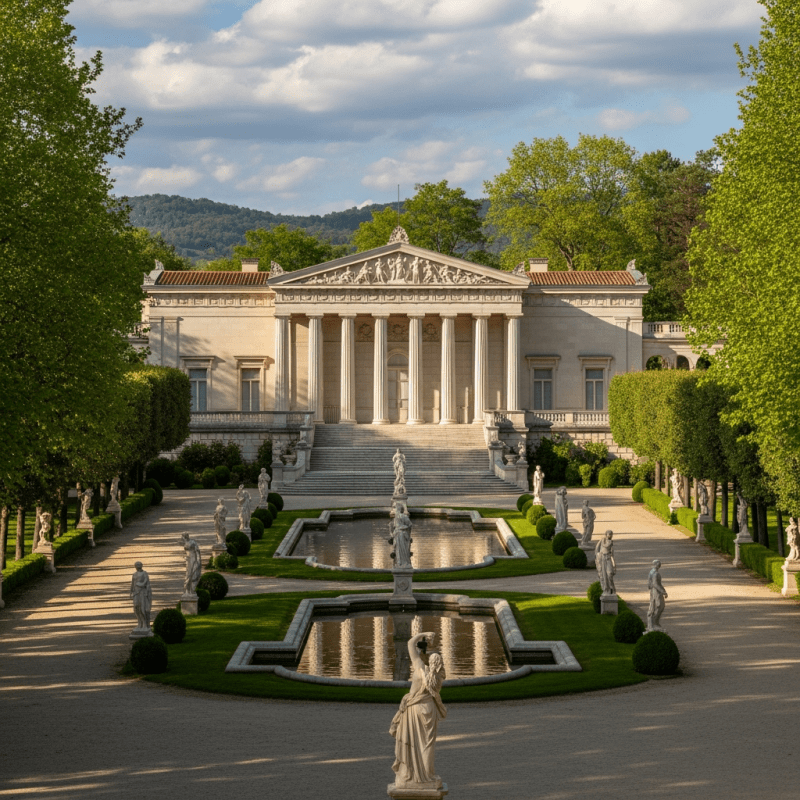
Soft cotton tee, unisex sizes
Buy ShirtNeoclassicism is deeply entwined with the ideals of the Enlightenment, representing reason, civic virtue, and the democratic values of antiquity. Its architecture has shaped the visual identity of capitals and cultural centers, from Washington, D.C. to St. Petersburg. The style’s references to classical antiquity have made it a symbol of legitimacy and power, frequently adopted for national monuments and institutions. In art and literature, Neoclassicism is associated with clarity, discipline, and moral purpose.
Neoclassical architecture flourished from circa 1750 to 1850, with regional continuations and revivals into the late 19th century. It originated in Europe—particularly France, Britain, and Italy—and spread rapidly to the United States, Russia, Germany, and throughout the Western world, leaving a lasting legacy on global architectural practice.

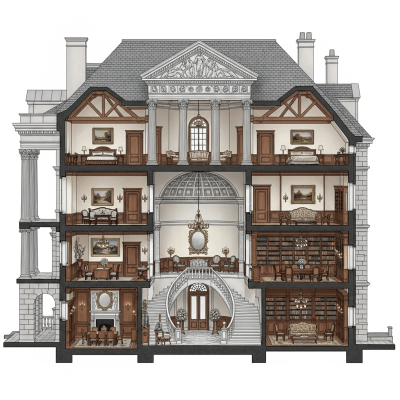
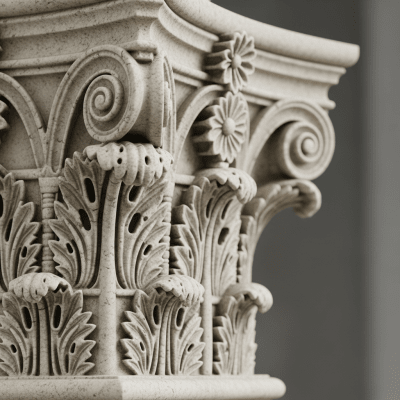
Neoclassical buildings are typically constructed from stone—limestone, marble, sandstone—alongside stucco and brick. Later examples incorporate cast iron and early steel frameworks. Load-bearing masonry is the primary technique, with increasing use of iron for structural support. Decorative motifs are carved or molded, and interiors may feature plasterwork and classical detailing.
Neoclassicism was directly inspired by ancient Greek and Roman architecture, as well as Renaissance Classicism and Palladianism. It emerged as a counterpoint to the ornate Baroque and Rococo styles. Related movements include Beaux-Arts, Neo-Grec, and various Neoclassical Revivals, which further interpreted classical principles in later eras.
Neoclassical architecture is widely recognized and protected for its cultural and historical significance. Many buildings are UNESCO World Heritage Sites, such as the historic centers of St. Petersburg, Paris, and Washington, D.C. The style is officially catalogued by bodies like the Getty AAT and is referenced in architectural education and heritage preservation worldwide.