
Modernism
Modernism is a transformative architectural movement of the 20th century, defined by its embrace of new materials, functional clarity, and a decisive break from historical styles.
Modernism is a transformative architectural movement of the 20th century, defined by its embrace of new materials, functional clarity, and a decisive break from historical styles.
Modernism originated in Western Europe around the turn of the 20th century, emerging from the social upheaval and technological advances brought on by industrialization and the aftermath of World War I. Architects sought to create a new design language for a rapidly changing world, rejecting ornate traditions in favor of rationality, simplicity, and innovation. The movement quickly spread globally, influencing urban landscapes from North America to Asia and beyond.
Modernism is both a school and a style within the architecture taxonomy. It encompasses a range of substyles—such as International Style, Bauhaus, Brutalism, Expressionism, and Constructivism—each reflecting the core principles of the movement while adapting to local contexts. Modernism stands apart from earlier traditions by prioritizing function and technological progress over historical reference.
Modernist buildings are visually striking for their geometric, rectilinear forms, open floor plans, and flat roofs. They feature extensive use of glass, steel, and reinforced concrete, with facades often marked by ribbon windows, pilotis (columns), and curtain walls. Ornamentation is deliberately avoided, resulting in a clean, uncluttered aesthetic that emphasizes structural honesty and spatial clarity.
Modernism revolutionized how buildings function for people and communities. Its principles were applied to a wide array of typologies—residential housing, office towers, schools, museums, and even entire urban plans. The movement championed adaptable, efficient spaces, with modular construction and open layouts that could flexibly serve changing needs. Social progress and accessibility were central, aiming to improve everyday life through design.
Bring this kind into your world illustrated posters, mugs, and shirts.

Archival print, museum-grade paper
Buy Poster
Stoneware mug, dishwasher safe
Buy Mug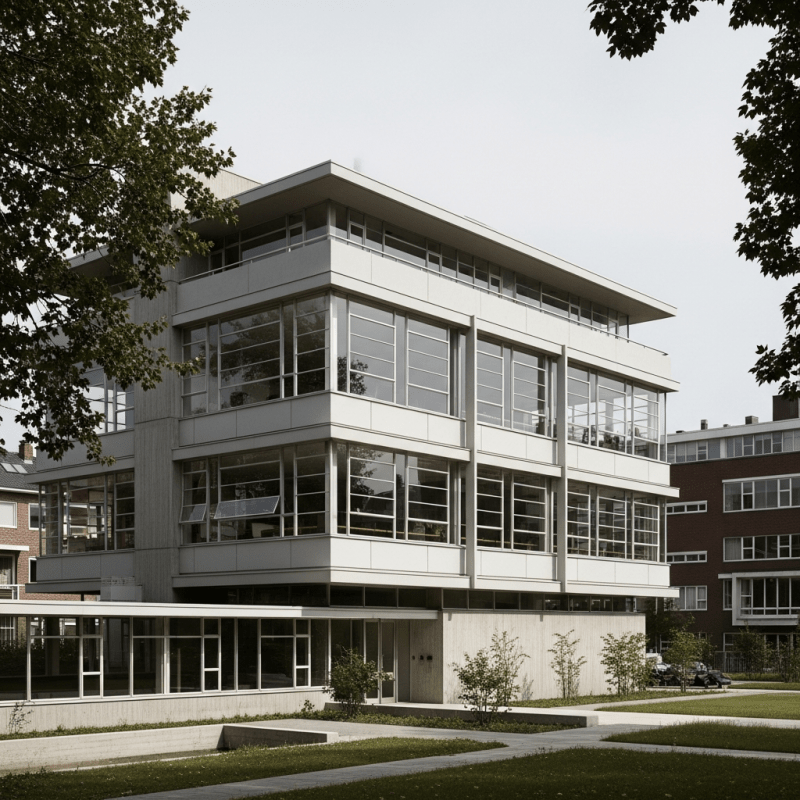
Soft cotton tee, unisex sizes
Buy ShirtModernism profoundly shaped 20th-century culture, symbolizing progress, innovation, and a break with the past. Its influence extends beyond architecture into art, design, and urban planning. Iconic modernist buildings are celebrated in popular media, museum exhibitions, and heritage programs, while the movement’s ideals—such as "form follows function"—continue to inspire contemporary design thinking worldwide.
Modernism flourished from circa 1900 to 1970, originating in Western Europe—especially Germany, France, and the Netherlands—before spreading rapidly to North America, Latin America, Eastern Europe, Asia, Africa, and Australia. Its global reach led to distinctive local adaptations and enduring influence in many regions.
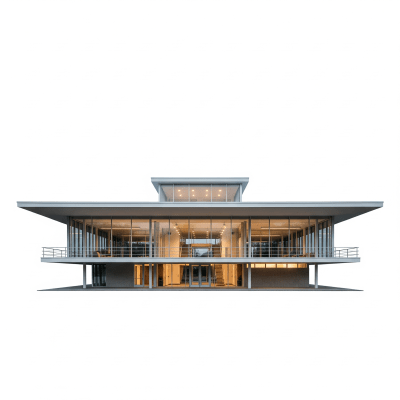

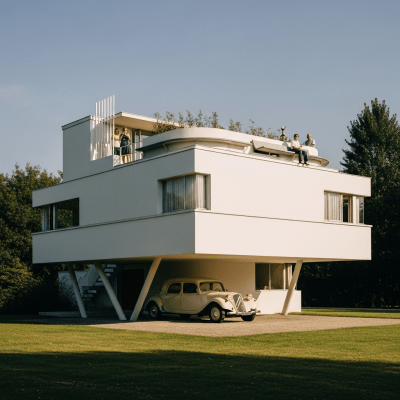

Modernist architecture is built with industrial materials such as reinforced concrete, steel, and glass. Prefabrication and modular construction are common, enabling efficient building processes and flexible designs. Innovative structural systems—like curtain walls and pilotis—allow for open, adaptable interiors and striking exterior forms.
Modernism was shaped by the Industrial Revolution, Arts and Crafts Movement, Art Nouveau, De Stijl, Constructivism, and Expressionism. Its legacy includes related styles such as Brutalism, Postmodernism, High-Tech, Minimalism, and Organic Architecture. Regional adaptations and hybrids—like Tropical Modernism or Japanese Metabolism—demonstrate its versatility and enduring relevance.
Modernist architecture is widely recognized and protected as cultural heritage. UNESCO has designated several Modernist sites, including the works of Le Corbusier, the Bauhaus buildings in Germany, and Brasília in Brazil. Organizations like DOCOMOMO International are dedicated to documenting and preserving Modern Movement buildings, ensuring their legacy for future generations.