
International Style
The International Style is a modernist architectural movement defined by its clean lines, functional forms, and universal approach, shaping the global built environment from the 1920s onward.
The International Style is a modernist architectural movement defined by its clean lines, functional forms, and universal approach, shaping the global built environment from the 1920s onward.
Emerging in Western and Central Europe during the 1920s, the International Style was formally named in 1932 through a seminal exhibition at the Museum of Modern Art in New York. Rooted in the avant-garde philosophies of the Bauhaus and De Stijl, it responded to the rapid industrialization of the era, advocating for new materials and construction methods. Its influence quickly spread worldwide, especially after World War II, as architects sought a universal language for modern life.
The International Style belongs to the Modernism school of architecture, representing one of its most influential and globally recognized styles. Unlike regional or historicist traditions, it is characterized by its commitment to universality and its rejection of ornament and historical references, setting it apart from both its predecessors and contemporary movements.
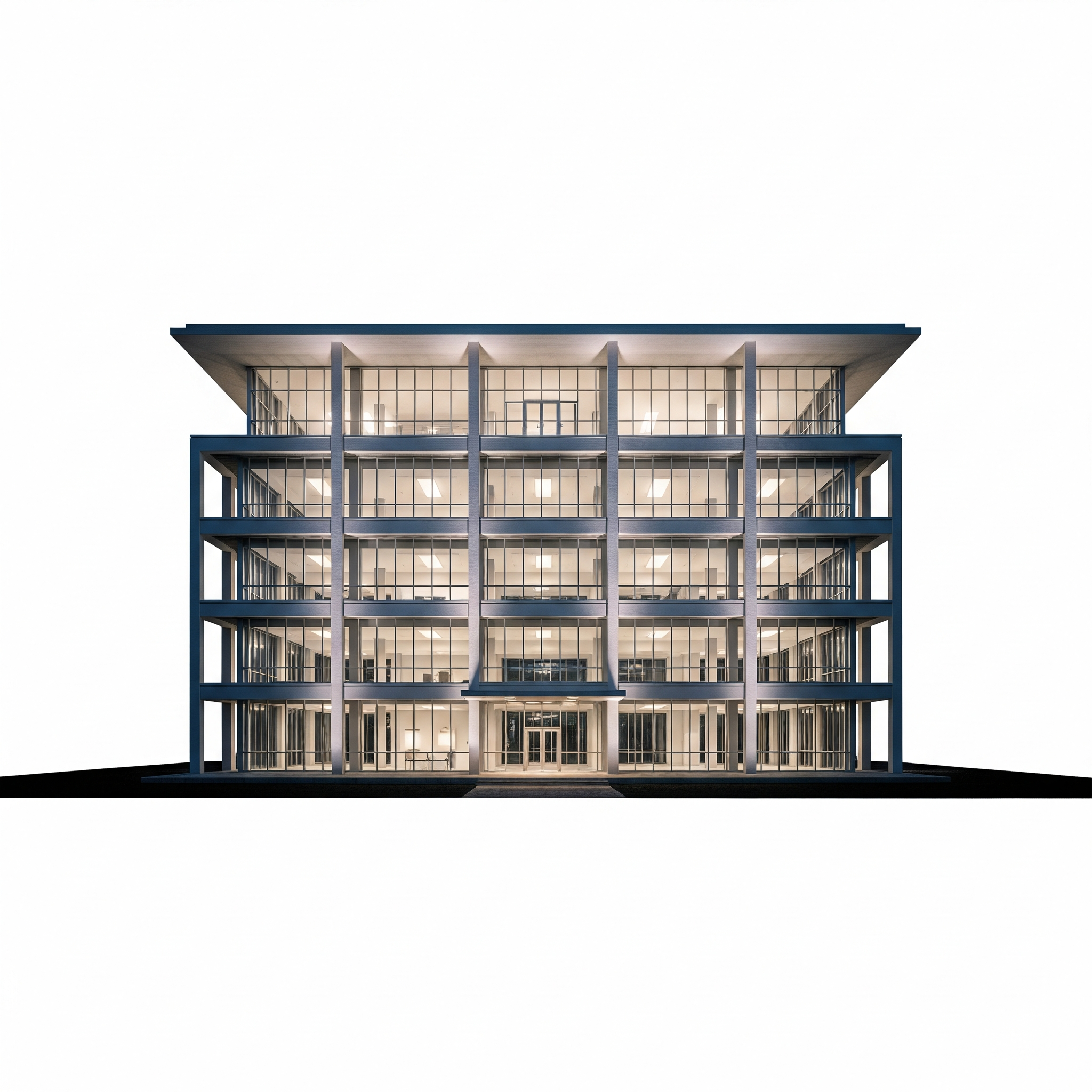
Buildings in the International Style are instantly recognizable for their rectilinear, planar forms and open interior spaces. Flat roofs, glass curtain walls, and steel frames create a sense of lightness and transparency. Ornament is deliberately omitted, and features such as ribbon windows and exposed structural elements emphasize function over decoration. The overall aesthetic is one of clarity, regularity, and geometric precision.
International Style architecture is designed for versatility and efficiency, serving a wide range of functions from office towers and residential blocks to airports and cultural institutions. Its modular construction and open plans facilitate flexible use, while the emphasis on industrial materials supports large-scale, cost-effective building. The style’s universality allows it to adapt to diverse urban contexts and climates.
Bring this kind into your world illustrated posters, mugs, and shirts.
Archival print, museum-grade paper
Buy Poster
Stoneware mug, dishwasher safe
Buy Mug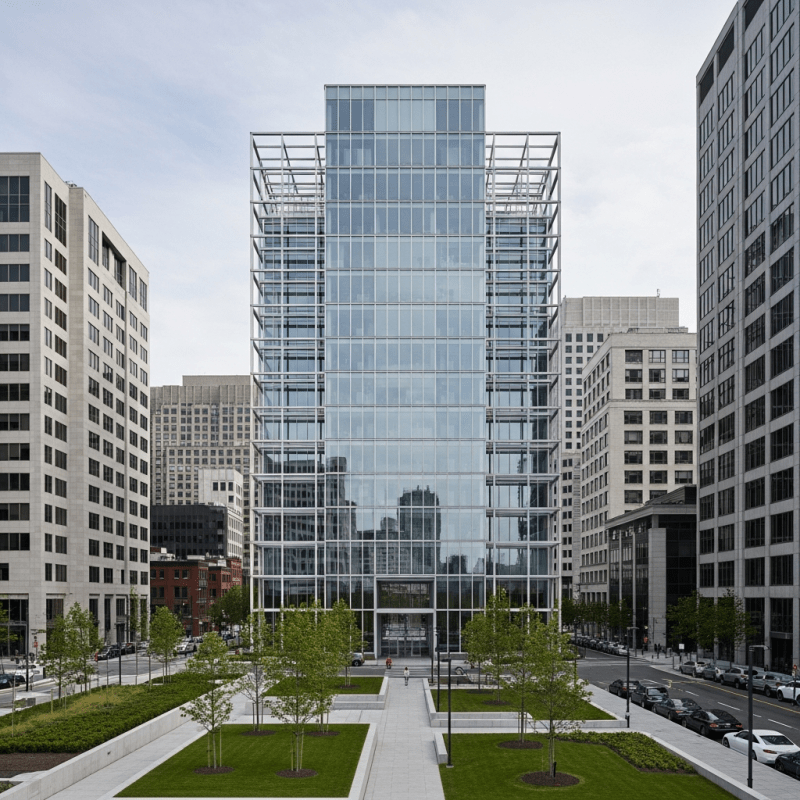
Soft cotton tee, unisex sizes
Buy ShirtAs a symbol of twentieth-century progress, the International Style has profoundly shaped the skylines of major cities around the world. It embodies ideals of rationality, egalitarianism, and technological advancement, influencing art, design, and popular culture. Many of its buildings are celebrated as architectural icons and have become protected heritage sites, reflecting their enduring impact on modern society.
Originating in Western and Central Europe during the 1920s, the International Style reached its zenith between the 1930s and 1960s. Its principles quickly spread to the United States, Latin America, and beyond, making it a truly global phenomenon throughout the twentieth century.

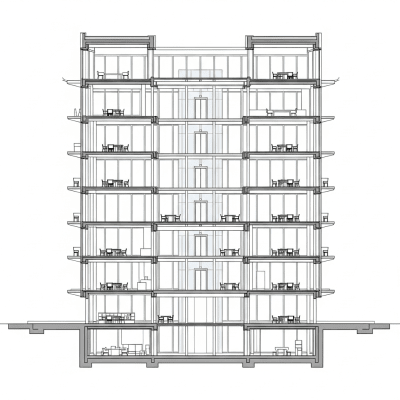


International Style buildings are constructed using glass curtain walls, steel frames, and reinforced concrete. Prefabrication and modular construction methods are common, allowing for efficient assembly and flexible design. Traditional masonry and decorative surfaces are typically avoided in favor of industrial materials and exposed structures.
The International Style draws direct inspiration from the Bauhaus, De Stijl, and Russian Constructivism. It is closely related to Brutalism, Mid-century Modern, and Minimalism, and later merged with regional modernisms. Its legacy also influenced the rise of Postmodernism, which reacted against its strict functionalism and lack of ornament.
Regional adaptations of the International Style include "Corporate Modernism" in the United States, "Functionalism" in Nordic and Eastern Europe, and "Estilo Internacional" in Latin America. The Bauhaus is often considered a German variant or precursor, while local climates and cultures have shaped the style’s expression in different parts of the world.
Many International Style buildings are recognized as heritage sites, including the Bauhaus Sites in Germany and Villa Savoye in France, both listed by UNESCO. Organizations like DOCOMOMO International actively document and advocate for the preservation of these modernist landmarks, acknowledging their foundational role in the history of architecture.