
Greek
Greek architecture is the ancient building tradition of Greece, celebrated for its iconic columns, harmonious proportions, and enduring influence on Western design.
Greek architecture is the ancient building tradition of Greece, celebrated for its iconic columns, harmonious proportions, and enduring influence on Western design.
Emerging around the 9th century BCE in the heart of ancient Greece, Greek architecture developed amidst a landscape of city-states and vibrant civic life. Its evolution was shaped by local resources, religious practices, and a quest for order and beauty, reaching its zenith during the Classical period before spreading through the Hellenistic world and influencing neighboring cultures.
Greek architecture is a principal style within the Classical Architecture school. It is defined by distinct substyles—Doric, Ionic, and Corinthian orders—and by its chronological phases: Archaic, Classical, and Hellenistic. These categories help distinguish Greek architecture from related traditions such as Roman or Byzantine styles.
Greek buildings are instantly recognizable for their rectilinear layouts, grand colonnades, and symmetrical facades. Temples rise on stylobates, crowned with sculpted pediments and entablatures. The three column orders—Doric (plain and sturdy), Ionic (elegant with scrolls), and Corinthian (ornate with acanthus leaves)—define the visual vocabulary. Surfaces were originally painted in vivid colors, though most surviving examples now reveal the pale beauty of marble and limestone.
Greek architecture served both sacred and civic functions. Temples honored the gods, theatres hosted drama and music, stoas provided shelter for public gatherings, and agoras formed the heart of urban life. These spaces encouraged communal participation, reflecting the democratic and religious ideals of Greek society.
Bring this kind into your world illustrated posters, mugs, and shirts.

Archival print, museum-grade paper
Buy Poster
Stoneware mug, dishwasher safe
Buy Mug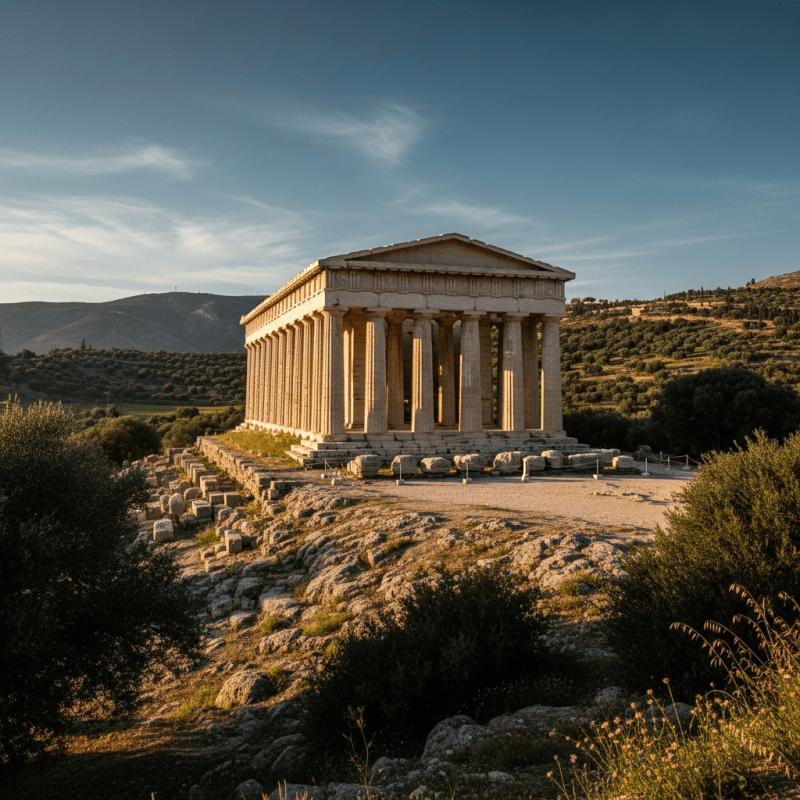
Soft cotton tee, unisex sizes
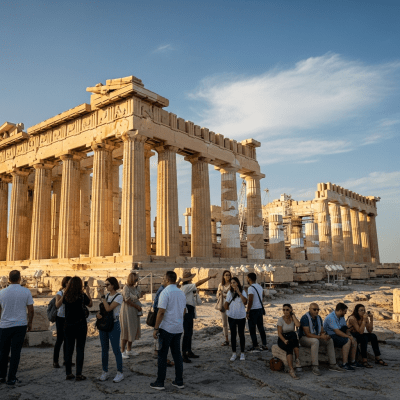
Buy ShirtAs a cornerstone of Western architectural heritage, Greek architecture symbolizes ideals of harmony, proportion, and rational beauty. Its forms and principles have been revived in countless eras—from Roman times to the Neoclassical movements of the 18th and 19th centuries—and remain central to architectural education and practice worldwide. Iconic sites like the Acropolis of Athens inspire art, literature, and popular imagination.
Greek architecture flourished from circa 900 BCE to 100 BCE, originating in mainland Greece and spreading to the Aegean Islands, western Asia Minor, and Magna Graecia in southern Italy and Sicily. Its influence extended throughout the Mediterranean world during the Hellenistic era.

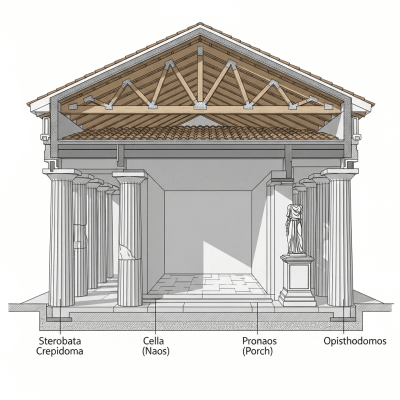

Greek builders primarily used local stone—limestone and marble—for walls and columns, with wood for early roof structures and terracotta for roof tiles and decorative details. Ashlar masonry and precise stone carving were standard, and architects employed optical refinements like entasis and subtle curvatures to achieve visual perfection.
Greek architecture drew early inspiration from Egyptian and Near Eastern monumental traditions. Its legacy directly shaped Roman architecture, which adopted and adapted Greek orders and forms. Later revivals include Hellenistic architecture, Neoclassical movements in Europe and America, and the spatial concepts of Byzantine design.
Greek architecture was adapted in colonies across Magna Graecia (southern Italy and Sicily) and in Ionian cities of Asia Minor. Regional distinctions also arose from the Doric, Ionian, and Corinthian orders, each reflecting local tastes and traditions. These variants contributed to a rich diversity within the Greek style.
Many Greek architectural sites are recognized as UNESCO World Heritage Sites, including the Acropolis of Athens, Sanctuary of Delphi, Sanctuary of Olympia, and the Temple of Apollo Epicurius at Bassae. These monuments are protected as national treasures, with ongoing preservation efforts ensuring their legacy for future generations. Greek architecture remains a foundational subject in global architectural education and heritage discourse.