
Deconstructivism
Deconstructivism is a late 20th-century architectural movement defined by fragmented forms, non-rectilinear shapes, and a radical break from conventional harmony and order in building design.
Deconstructivism is a late 20th-century architectural movement defined by fragmented forms, non-rectilinear shapes, and a radical break from conventional harmony and order in building design.
Deconstructivism originated in the 1980s, primarily in the United States and Western Europe. Its emergence was marked by the influential 1988 "Deconstructivist Architecture" exhibition at the Museum of Modern Art (MoMA) in New York, which showcased architects challenging the rationality and functionalism of modernism. Drawing inspiration from philosophical deconstruction—particularly the ideas of Jacques Derrida—the movement sought to disrupt established architectural norms, favoring unpredictability and conceptual complexity.
Deconstructivism is classified within the broader school of Modern/Postmodern Architecture. It stands as a distinct style that reacts against both the order of modernism and the eclecticism of postmodernism, emphasizing instability, fragmentation, and the rejection of absolute truths in design. While it shares certain experimental traits with Expressionism and Parametricism, Deconstructivism is recognized as a unique movement with no widely accepted substyles.
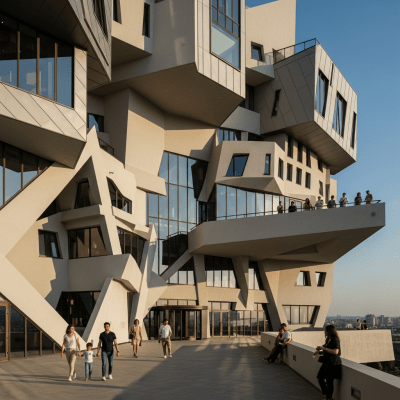
Deconstructivist buildings are visually striking, often appearing as if their forms have been pulled apart or distorted. Expect sharp angles, unexpected curves, and surfaces that seem to fold, twist, or collide. Traditional elements like walls and roofs are disrupted, creating a sense of chaos and unpredictability. The absence of symmetry and continuity results in structures that feel dynamic, sculptural, and conceptually layered, challenging the viewer’s sense of architectural order.
Deconstructivism has been applied to a wide array of building types, including museums, cultural centers, residences, and commercial buildings. These structures often serve as cultural landmarks, inviting interaction and contemplation. Their unconventional forms can provoke curiosity and debate, while advanced engineering and digital design tools enable functional spaces within seemingly chaotic exteriors. The movement’s emphasis on concept over function sometimes leads to innovative, if occasionally controversial, spatial experiences for users.
Bring this kind into your world illustrated posters, mugs, and shirts.

Archival print, museum-grade paper
Buy Poster
Stoneware mug, dishwasher safe
Buy Mug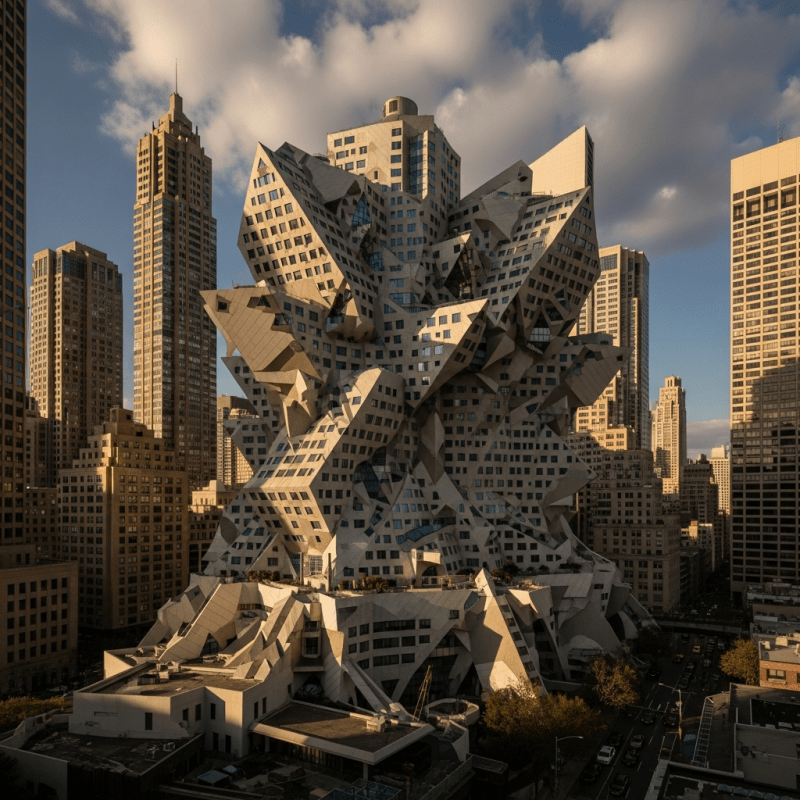
Soft cotton tee, unisex sizes
Buy ShirtDeconstructivism has left a lasting mark on contemporary architecture and urban culture. The Guggenheim Museum Bilbao, for example, is credited with sparking the "Bilbao Effect," revitalizing its city through iconic design. The movement’s philosophical roots in deconstruction have influenced not only architects but also artists and theorists, making Deconstructivism a symbol of creative disruption and intellectual challenge. Its buildings often become cultural touchstones, celebrated for their audacity and conceptual depth.
Deconstructivism emerged in the late 1980s and continues to influence architecture today. Its origins are rooted in the United States and Western Europe, particularly in cities like New York, Paris, Rotterdam, and Berlin. From its Western beginnings, the style has spread globally, with major works found in Spain, Germany, France, the Netherlands, and beyond.

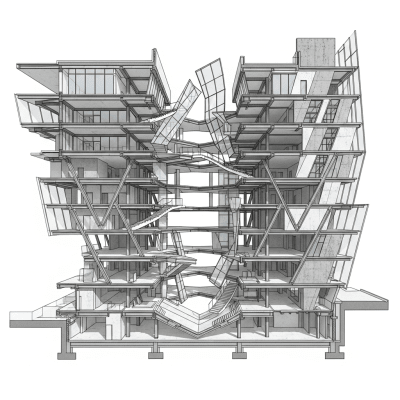

Deconstructivist buildings typically employ steel, glass, concrete, and other industrial materials. The realization of their complex forms is made possible by computer-aided design (CAD), parametric modeling, and innovative structural engineering. These techniques enable architects to create unconventional geometries and dynamic surfaces that would be impossible with traditional construction methods.
Deconstructivism draws inspiration from philosophical deconstruction (Jacques Derrida), Russian Constructivism, and the experimental later works of Le Corbusier. It is related to Postmodernism in its critique of modernist ideals, shares dynamic forms with Expressionism, and prefigures the digital complexity of Parametricism. Some buildings blend Deconstructivist principles with local traditions or sustainable design, creating hybrid forms.
While Deconstructivism has been adopted worldwide, there are no formally recognized regional substyles. Instead, architects in different countries have adapted its principles to local contexts, sometimes blending them with contemporary or vernacular idioms. This has led to unique interpretations, but the movement remains unified by its core philosophy and visual language.
Several Deconstructivist buildings are protected as contemporary architectural landmarks and are listed by organizations such as DOCOMOMO International. The Guggenheim Museum Bilbao is celebrated for its role in urban regeneration. Although few Deconstructivist works have attained UNESCO World Heritage status due to their recent construction, their cultural and architectural significance is widely recognized, and ongoing debates continue about their preservation and heritage value.