
Art Deco
Art Deco is a celebrated architectural style of the early 20th century, instantly recognizable for its bold geometric forms, lavish ornamentation, and embrace of modern materials and technology.
Art Deco is a celebrated architectural style of the early 20th century, instantly recognizable for its bold geometric forms, lavish ornamentation, and embrace of modern materials and technology.
Art Deco originated in France, gaining international prominence after its dazzling showcase at the 1925 Exposition Internationale des Arts Décoratifs et Industriels Modernes in Paris. Emerging in the aftermath of World War I, the style reflected a spirit of optimism, luxury, and progress. Its influence quickly spread across Europe, North America, Latin America, Asia, and Oceania, adapting to local cultures and urban landscapes.
Art Deco is classified within the Modern Architecture school, distinct for its synthesis of traditional craftsmanship with industrial-age aesthetics. It stands apart from its contemporaries by balancing ornamental richness with streamlined, machine-age forms, and encompasses notable substyles such as Streamline Moderne and Zigzag Moderne.
Art Deco buildings captivate with their strong geometric shapes—zigzags, chevrons, stepped profiles, and sunbursts—often arranged in symmetrical facades with a pronounced vertical emphasis. Surfaces gleam with chrome, glass, and exotic stones, while stylized motifs of flora, fauna, and radiating patterns adorn both interiors and exteriors. The overall effect is one of dynamic elegance, blending opulence with the sleek lines of industrial progress.
Art Deco architecture was designed to impress and inspire, serving as the visual language of progress and modernity. Its functional range is broad: from iconic skyscrapers and glamorous cinemas to hotels, government buildings, apartment blocks, and transportation hubs. The style’s adaptability allowed it to shape both monumental city skylines and everyday urban environments, making it a favorite for public and commercial spaces seeking to project sophistication and optimism.
Bring this kind into your world illustrated posters, mugs, and shirts.

Archival print, museum-grade paper
Buy Poster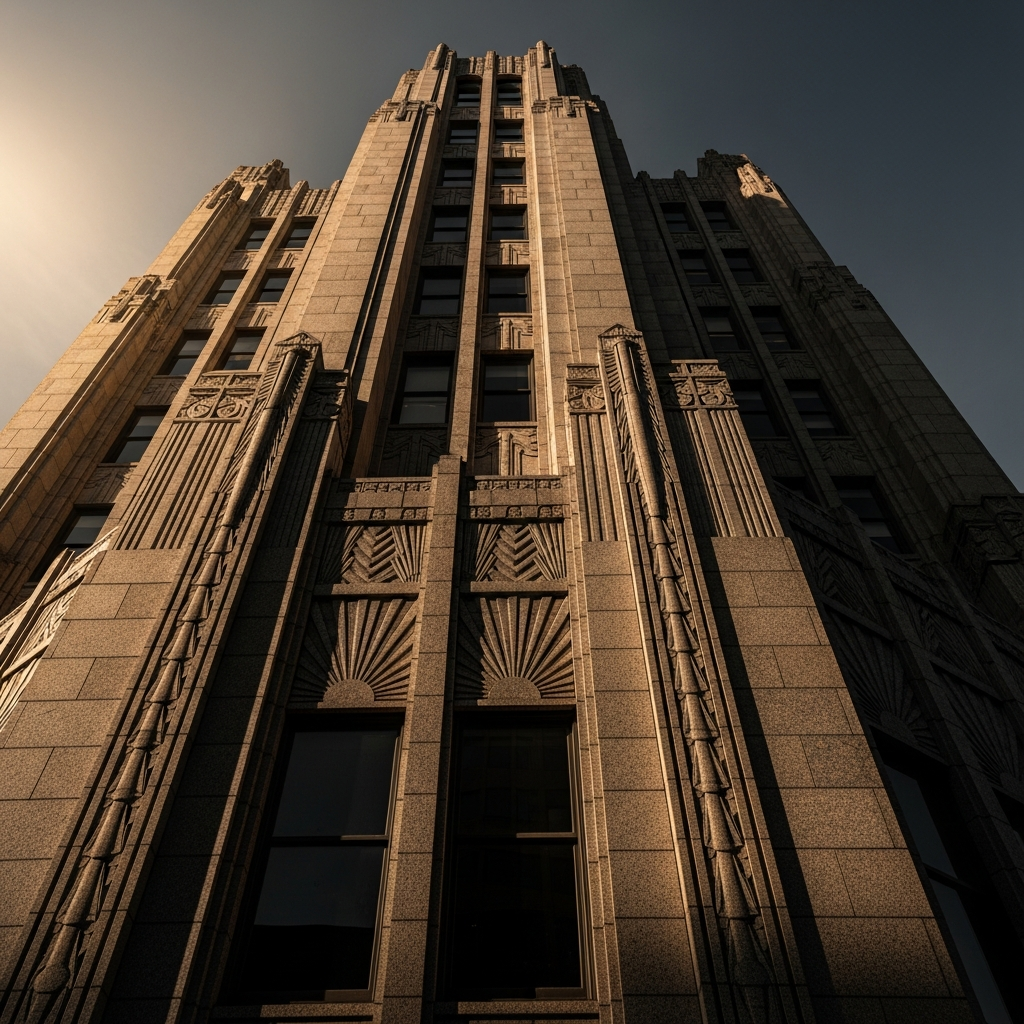
Stoneware mug, dishwasher safe
Buy Mug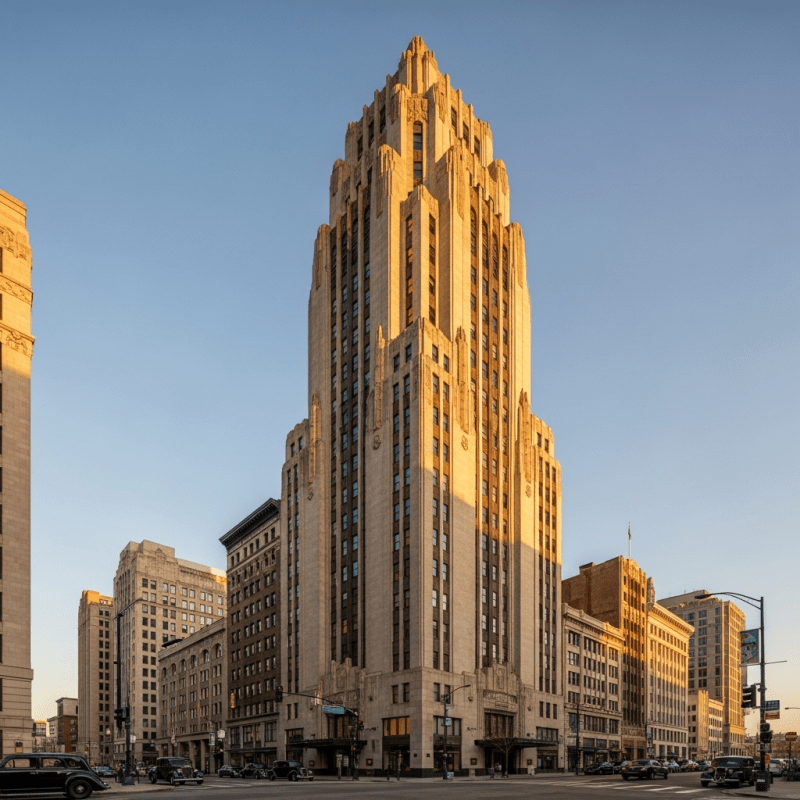
Soft cotton tee, unisex sizes
Buy ShirtArt Deco became synonymous with the exuberance of the Jazz Age and the optimism of the interwar period. Its influence extended beyond architecture to fashion, graphic design, and film, embodying the spirit of technological advancement and luxury. Today, Art Deco remains a symbol of urban glamour, its buildings cherished as cultural icons and protected heritage sites in cities worldwide.
Art Deco flourished from circa 1919 to 1940, with its peak between 1925 and 1939. Born in France, it rapidly gained global traction, leaving its mark on cities across Europe, North America, Latin America, Asia, and Oceania.
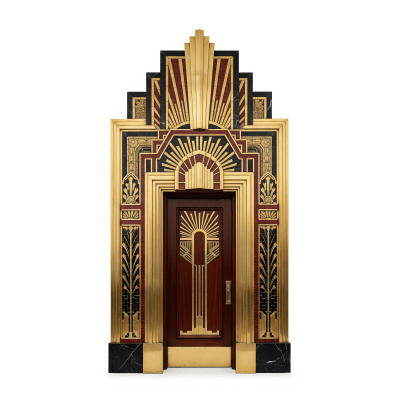
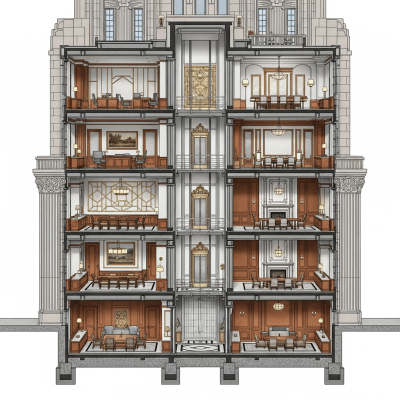
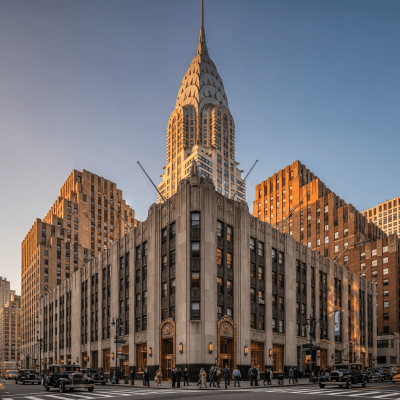

Art Deco’s signature traits include bold geometric shapes, vertical emphasis, streamlined curves, symmetrical facades, and a synthesis of traditional and industrial-age aesthetics. Decorative motifs—such as stylized flora, fauna, sunbursts, and fountains—are rendered in bas-relief and sculptural ornament, celebrating luxury and technological progress.
Art Deco architects embraced modern materials like reinforced concrete, steel, glass, aluminum, and chrome, often paired with exotic stones such as marble and onyx. Decorative inlays of ivory, lacquer, and rare woods added richness. Construction techniques featured machine-age methods, prefabrication, intricate metalwork, and innovative lighting, all contributing to the style’s unique blend of artistry and engineering.
Art Deco drew inspiration from Cubism, Futurism, Constructivism, Egyptian Revival, Beaux-Arts, and the Arts and Crafts movement. Its contemporaries and successors include Bauhaus (emphasizing function over ornament), International Style (minimalist and less decorative), and Streamline Moderne (a late, curvilinear phase). Neo-Art Deco revivals and hybridizations have continued to reinterpret the style in later decades.
Art Deco adapted to local cultures, resulting in distinctive regional variants. Streamline Moderne in the USA introduced aerodynamic curves and nautical motifs; Zigzag Moderne in France emphasized sharp angles; Tropical Deco in South Florida featured pastel colors and marine themes; and PWA Moderne reflected American public works projects. In Latin America, Asia, and Africa, local motifs and materials were often integrated, creating unique blends of Art Deco expression.
Art Deco’s legacy is honored through official designations and active preservation. The Miami Beach Art Deco Historic District is a protected zone, and several Art Deco buildings—such as Palacio de Bellas Artes—have achieved or are proposed for UNESCO World Heritage status. International bodies like DOCOMOMO, RIBA, and AIA recognize the style’s cultural importance, while ongoing conservation efforts safeguard its enduring presence in urban landscapes.