
Royal Fern Family
Osmundaceae is a globally distributed family of ferns distinguished by their large, pinnate fronds and unique fertile frond morphology bearing naked sporangia.
Osmundaceae is a globally distributed family of ferns distinguished by their large, pinnate fronds and unique fertile frond morphology bearing naked sporangia.
The Osmundaceae family was formally described in 1810 by Robert Brown, with its type genus Osmunda recognized as one of the most ancient lineages among extant ferns. Fossil evidence traces its origins back to the Mesozoic era, highlighting its deep evolutionary history within vascular plants.
Osmundaceae belongs to the order Osmundales within the class Polypodiopsida and division Monilophyta, encompassing genera such as Osmunda, Leptopteris, and Todea. Molecular phylogenetic studies confirm the family as a monophyletic group, though relationships among its genera continue to be refined.
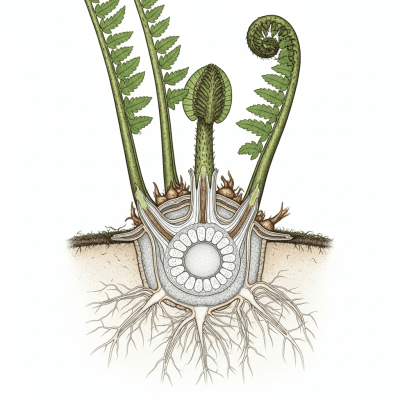
Members of Osmundaceae typically exhibit large, pinnate to bipinnate fronds emerging from stout, upright rhizomes. Their fertile fronds are morphologically distinct, bearing large, naked sporangia that are not clustered into sori, a key identifying feature that sets them apart from many other ferns.
These terrestrial ferns thrive in moist, acidic soils often found in wetland and riparian habitats. They are long-lived perennials with slow vegetative spread and notable resistance to waterlogging. While primarily wild plants, some species like Osmunda regalis and Osmunda cinnamomea are occasionally cultivated for their ornamental foliage.
Bring this kind into your world illustrated posters, mugs, and shirts.

Archival print, museum-grade paper
Buy Poster
Stoneware mug, dishwasher safe
Buy Mug
Soft cotton tee, unisex sizes
Buy ShirtOsmundaceae ferns have historically been valued in horticulture for their elegant fronds. Additionally, the fibrous roots of certain species have been used as potting media for orchids. Though limited, some regional traditions have consumed young fiddleheads, reflecting a modest cultural interaction with these plants.
Osmundaceae ferns reproduce via spores produced on specialized fertile fronds. Their life cycle includes an alternation between a dominant sporophyte phase, which bears the large pinnate fronds, and a smaller, independent gametophyte stage. The naked sporangia on fertile fronds release spores that germinate into gametophytes, which then produce gametes for fertilization, completing the cycle.





These ferns play vital roles in wetland and riparian ecosystems by stabilizing soil and contributing to habitat complexity. Their presence supports biodiversity by providing shelter and microhabitats for various invertebrates and influencing moisture retention in their environments.
Osmundaceae ferns are generally stable across their broad native range, with no major widespread threats documented. Their preference for moist habitats means they can be vulnerable to wetland drainage and habitat loss, but conservation efforts in protected areas help maintain their populations.
Notable species within Osmundaceae include Osmunda regalis (royal fern) and Osmunda cinnamomea (cinnamon fern), both valued for their ornamental qualities. These species are among the most widely recognized and cultivated representatives of the family.