
Siki's Crested Gibbon
Siki's crested gibbon (Nomascus siki) is a species of lesser ape native to central Vietnam and Laos, known for its striking sexual dichromatism and distinctive vocal duets.
Siki's crested gibbon (Nomascus siki) is a species of lesser ape native to central Vietnam and Laos, known for its striking sexual dichromatism and distinctive vocal duets.
First described by Thomas in 1909 from specimens collected in central Indochina, Siki's crested gibbon belongs to the genus Nomascus within the family Hylobatidae. Its discovery marked an important addition to the group of crested gibbons inhabiting Southeast Asia, though ongoing research continues to refine its precise boundaries and relationships with neighboring taxa.
Siki's crested gibbon is classified as a species within the lesser apes, family Hylobatidae, genus Nomascus. It is closely related to other crested gibbons such as Nomascus concolor and Nomascus leucogenys, with some populations showing evidence of hybridization in overlapping ranges.
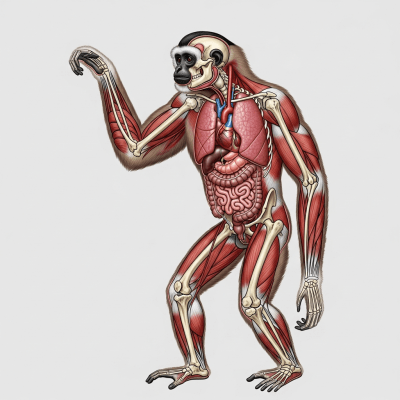
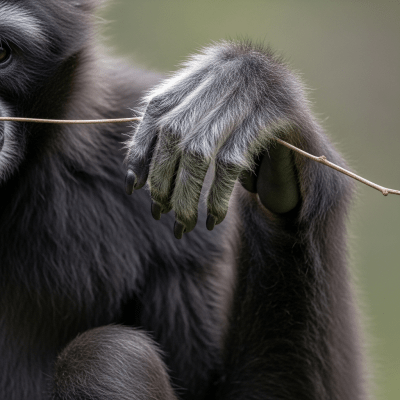
This species exhibits marked sexual dichromatism: males are predominantly black with pale cheeks, while females display buff or golden fur accented by darker facial markings. Adults typically measure between 45 and 60 centimeters in body length and weigh from 6 to 8 kilograms. Their arboreal form is adapted for brachiation, allowing agile movement through the forest canopy.
Siki's crested gibbons are highly arboreal and rarely descend to the ground. They are renowned for their complex vocal duets, which serve to defend territories and strengthen pair bonds. These vocalizations are a key aspect of their social behavior and communication within dense forest habitats.
Bring this kind into your world illustrated posters, mugs, and shirts.

Archival print, museum-grade paper
Buy Poster
Stoneware mug, dishwasher safe
Buy Mug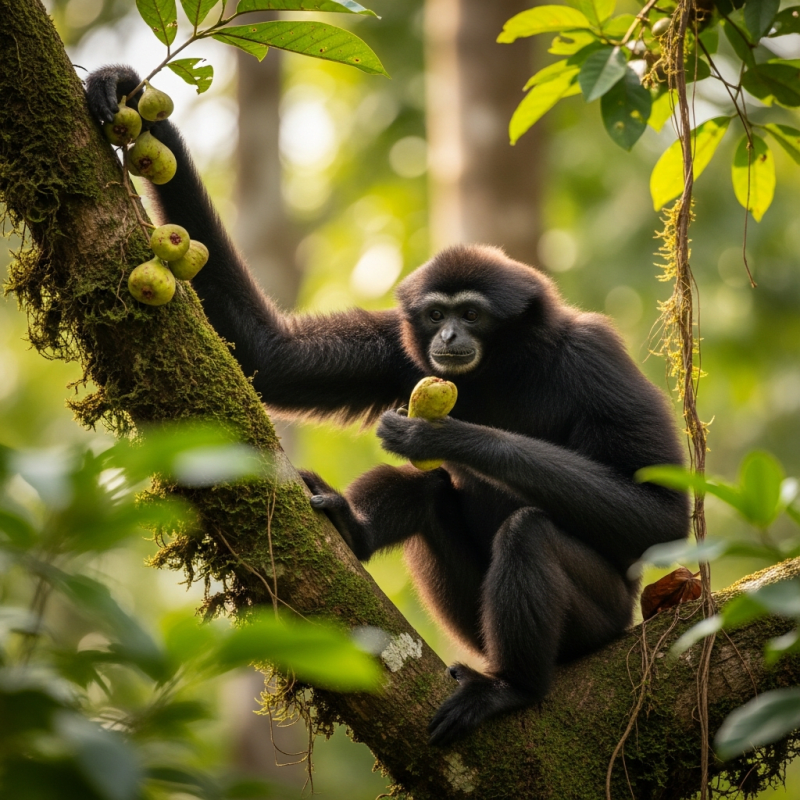
Soft cotton tee, unisex sizes
Buy ShirtWhile Siki's crested gibbon does not hold widespread cultural prominence, it is locally recognized in Vietnam and Laos, where it is known by names such as "Vượn siki." Unfortunately, the species is sometimes targeted in traditional medicine and illegal pet trade, reflecting a challenging intersection between cultural practices and conservation.
Found primarily in the evergreen forests of central Vietnam and Laos, Siki's crested gibbon prefers mature canopy cover in both primary and secondary forest environments. Its distribution is limited and fragmented, reflecting pressures from habitat degradation and human activity.



Although specific studies on Siki's crested gibbon social organization are limited, like other crested gibbons, it likely lives in small, monogamous family groups. Vocal duets between mated pairs play a central role in maintaining territory and social bonds.
Detailed dietary information for Siki's crested gibbon is scarce, but it is presumed to be frugivorous and folivorous like other gibbons, feeding primarily on fruits, leaves, and occasionally flowers found in the forest canopy.
⚠️ Conservation status: Siki's crested gibbon is listed as Endangered due to ongoing habitat loss, hunting, and capture for the illegal pet trade and traditional medicine. Protecting its forest habitat and curbing poaching are critical for its survival.
Genetically, Siki's crested gibbon shares close evolutionary ties with other members of the genus Nomascus. Hybridization events have been reported in zones where its range overlaps with related species, highlighting complex evolutionary relationships within crested gibbons.