
Northern White-Cheeked Gibbon
The Northern white-cheeked gibbon (Nomascus leucogenys) is a critically endangered lesser ape native to Southeast Asia, renowned for its striking sexual dimorphism and powerful vocal duets.
The Northern white-cheeked gibbon (Nomascus leucogenys) is a critically endangered lesser ape native to Southeast Asia, renowned for its striking sexual dimorphism and powerful vocal duets.
First described by Ogilby in 1840 from specimens in northern Vietnam, the Northern white-cheeked gibbon has its roots in the subtropical forests of northern Vietnam, Laos, and historically southern China. Its discovery marked an important addition to the genus Nomascus, highlighting the rich primate diversity of the region.
This species belongs to the superfamily Hominoidea, family Hylobatidae, and genus Nomascus. It is closely related to other crested gibbons such as Nomascus siki and Nomascus gabriellae, sharing a lineage supported by molecular phylogenetic studies.
The Northern white-cheeked gibbon exhibits notable sexual dimorphism: adult males are predominantly black with distinctive white cheek patches and a crest, while females display a golden or buff coat with a black cap and lack the white cheeks. Juveniles are born buff-colored, with males darkening as they mature. Adults typically measure 45 to 60 cm in body length and weigh between 6 and 8 kilograms.
Arboreal and highly territorial, these gibbons move through the forest canopy using brachiation, swinging hand-over-hand with remarkable agility. They form small, monogamous family groups consisting of a pair and their offspring. Their complex and loud vocal duets serve to defend territory and strengthen pair bonds, especially during morning hours.
Bring this kind into your world illustrated posters, mugs, and shirts.

Archival print, museum-grade paper
Buy Poster
Stoneware mug, dishwasher safe
Buy Mug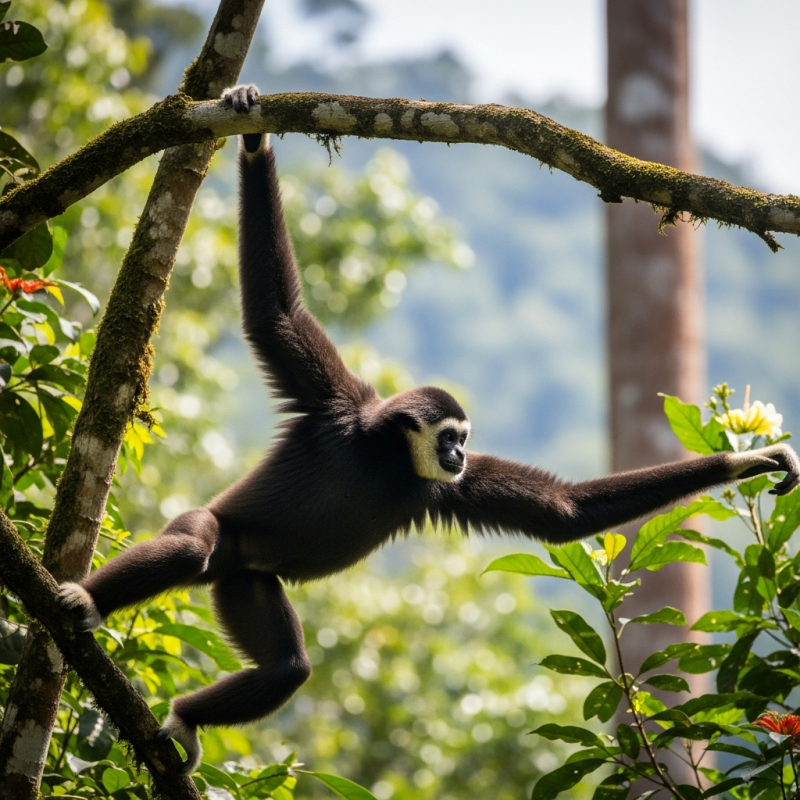
Soft cotton tee, unisex sizes
Buy ShirtWhile the Northern white-cheeked gibbon holds no recognized culinary value, it is culturally significant in local traditions and conservation efforts. It serves as a flagship species for forest preservation in its native range and symbolizes the urgent need to protect Southeast Asia’s biodiversity from human threats.
Native to mountainous subtropical and tropical moist broadleaf forests, the Northern white-cheeked gibbon occupies elevations from 200 to 2,000 meters. Its range spans northern Vietnam and Laos, with historical presence in southern China. The species depends on intact forest canopies for movement and foraging.




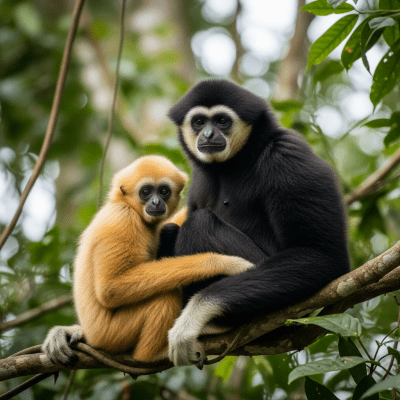
This gibbon lives in small, highly territorial family groups formed by monogamous pairs and their offspring. These tight-knit units defend their territory through vocalizations and physical displays, maintaining stable social bonds within the dense forest environment.
While specific dietary details are limited, Northern white-cheeked gibbons are primarily frugivorous, feeding on a variety of fruits found in their forest habitats. Their arboreal lifestyle allows them to access diverse food sources, including leaves and flowers, supporting their energetic needs.
Classified as Critically Endangered, the Northern white-cheeked gibbon faces severe threats from habitat fragmentation, hunting, and human disturbance. Illegal capture for the pet trade and use in traditional medicine further endanger the species. Conservation efforts focus on habitat protection and anti-poaching measures, with international trade regulated under CITES Appendix I.
Genetically, the Northern white-cheeked gibbon belongs to the genus Nomascus, sharing close evolutionary ties with species like Nomascus siki. Occasional hybridization occurs in contact zones, reflecting ongoing gene flow within this group. Molecular studies have clarified its phylogenetic placement among crested gibbons, underscoring its distinct species status.