
Northern Crested Gibbon
The Northern crested gibbon (Nomascus nasutus) is a critically endangered lesser ape known for its striking sexual dichromatism and distinctive vocalizations, native to a limited region along the Vietnam-China border.
The Northern crested gibbon (Nomascus nasutus) is a critically endangered lesser ape known for its striking sexual dichromatism and distinctive vocalizations, native to a limited region along the Vietnam-China border.
First described by Thomas in 1909 from specimens collected in northern Vietnam, the Northern crested gibbon has a taxonomic history intertwined with closely related crested gibbons. Once considered a subspecies of Nomascus concolor, it is now recognized as a distinct species based on morphological, vocal, and genetic evidence.
The Northern crested gibbon belongs to the family Hylobatidae, commonly known as gibbons or lesser apes, within the genus Nomascus. It is part of the superfamily Hominoidea, which encompasses all apes, and is closely related to other crested gibbons distinguished by their characteristic crests and vocal traits.
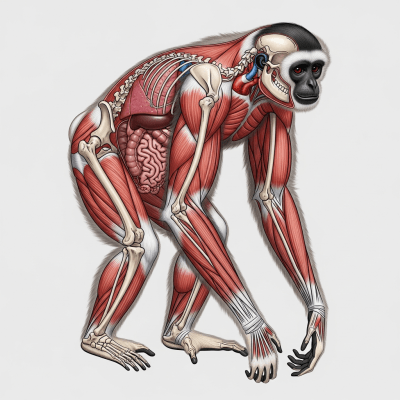
This small arboreal ape exhibits marked sexual dichromatism: males are predominantly black with a prominent crest atop their heads, while females display buff or golden fur with a contrasting black cap. Adults typically measure between 45 and 60 centimeters in length and weigh 7 to 8 kilograms. Their long arms are perfectly adapted for brachiation, enabling agile movement through the forest canopy, and like all apes, they lack tails.
Northern crested gibbons are known for their complex, species-specific vocalizations used in territory defense and strengthening pair bonds. They live primarily in monogamous family groups, exhibiting low reproductive rates with interbirth intervals of two to three years. Their arboreal lifestyle and social behaviors are finely tuned to the subtropical evergreen forests they inhabit.
Bring this kind into your world illustrated posters, mugs, and shirts.

Archival print, museum-grade paper
Buy Poster
Stoneware mug, dishwasher safe
Buy Mug
Soft cotton tee, unisex sizes
Buy ShirtWhile not widely prominent in commercial or culinary contexts, the Northern crested gibbon holds cultural value in its native range. It occasionally appears in local folklore and supports ecotourism initiatives that emphasize conservation. Despite its rarity, the species symbolizes the fragile biodiversity of the Vietnam-China border region.
Endemic to a small geographic range along the border of northern Vietnam and southern China, the Northern crested gibbon inhabits subtropical evergreen forests at elevations ranging from 200 to 800 meters. Its habitat is highly fragmented due to human activities, limiting its distribution and contributing to its critical conservation status.





The Northern crested gibbon typically forms small, monogamous family groups consisting of a mated pair and their offspring. This social organization supports strong pair bonds and cooperative care of young, with low reproductive rates reflecting their slow life history strategy.
While specific dietary details are limited, Northern crested gibbons, like other gibbons, primarily consume a frugivorous diet supplemented by leaves, flowers, and insects. Their feeding behavior is adapted to an arboreal lifestyle, foraging across the forest canopy.
Classified as Critically Endangered, the Northern crested gibbon faces severe threats from habitat disturbance and fragmentation driven by deforestation and land conversion. Illegal hunting for bushmeat and traditional medicine occurs but is less widespread. The species is listed on CITES Appendix I, prohibiting all international trade, yet conservation efforts remain challenged by its restricted range and low population numbers.
Genetic studies have confirmed the Northern crested gibbon as a distinct species, separate from its close relatives like Nomascus concolor. No hybridization events have been documented in the wild or captivity. Its evolutionary lineage places it firmly within the crested gibbons, a group characterized by unique vocal and morphological traits.