
Müller's Gibbon
Müller's gibbon (Hylobates muelleri) is a small, agile lesser ape native to the island of Borneo, known for its exceptional brachiation skills and distinctive vocalizations within the forest canopy.
Müller's gibbon (Hylobates muelleri) is a small, agile lesser ape native to the island of Borneo, known for its exceptional brachiation skills and distinctive vocalizations within the forest canopy.
Müller's gibbon was first formally described by Martin in 1841, with its type locality on Borneo. It evolved through allopatric speciation in Southeast Asia, diverging from related gibbon species within the genus Hylobates. Its lineage reflects a long-standing presence in Borneo's tropical forests.
This species belongs to the family Hylobatidae, commonly known as the lesser apes, within the superfamily Hominoidea. It is classified under the genus Hylobates, grouping it with other Southeast Asian gibbons. Some taxonomic authorities recognize three subspecies, though this remains under review pending further genetic study.
Müller's gibbon is characterized by a small, slender body measuring approximately 44 to 63 centimeters in length and weighing between 4 and 8 kilograms. Its fur ranges from pale gray to brownish shades, accented by lighter facial rings and hands. Notably, it possesses long arms perfectly adapted for swift brachiation through the forest canopy.
This diurnal ape is highly arboreal, rarely descending to the ground. It typically lives in monogamous pairs with offspring, defending small, stable territories. Communication is marked by loud, complex vocalizations that serve both territorial and social functions. Müller's gibbon plays a vital ecological role in seed dispersal within its habitat.
Bring this kind into your world illustrated posters, mugs, and shirts.

Archival print, museum-grade paper
Buy Poster
Stoneware mug, dishwasher safe
Buy Mug
Soft cotton tee, unisex sizes
Buy ShirtWhile not widely prominent in global culture, Müller's gibbon holds local significance in Borneo, where it is sometimes known as "Kelawat." It serves as a flagship species for forest conservation efforts and ecotourism, symbolizing the rich biodiversity of the island's rainforests.
Endemic to Borneo, Müller's gibbon inhabits tropical rainforests, primarily occupying the upper canopy layers. It thrives in dense, undisturbed forest environments where it can brachiate freely. Its distribution is limited to this island, making its habitat range relatively restricted.





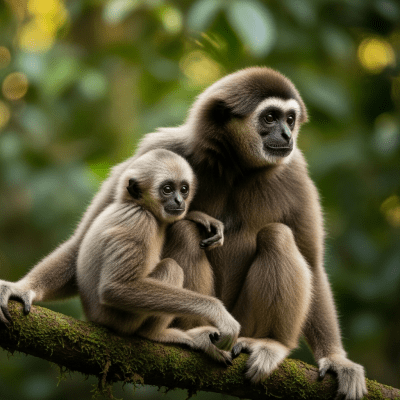
Müller's gibbon typically forms small family groups consisting of monogamous pairs and their offspring. These groups maintain and defend stable territories through vocalizations and physical presence. Social bonds are reinforced by duet singing, a hallmark of gibbon communication.
While specific dietary details are limited, Müller's gibbon, like other gibbons, primarily feeds on fruits, supplemented by leaves, flowers, and occasionally insects. Its feeding behavior supports seed dispersal, contributing to forest regeneration.
Listed as Endangered, Müller's gibbon faces significant threats from habitat loss due to deforestation and land conversion in Borneo. Illegal hunting and the pet trade also pose risks. Conservation efforts focus on habitat protection and enforcement of legal protections under CITES Appendix I.
Genetic studies place Müller's gibbon firmly within the genus Hylobates, with divergence driven by geographic isolation in Southeast Asia. No hybridization events have been documented. Its evolutionary history reflects adaptation to arboreal life and vocal communication within dense tropical forests.