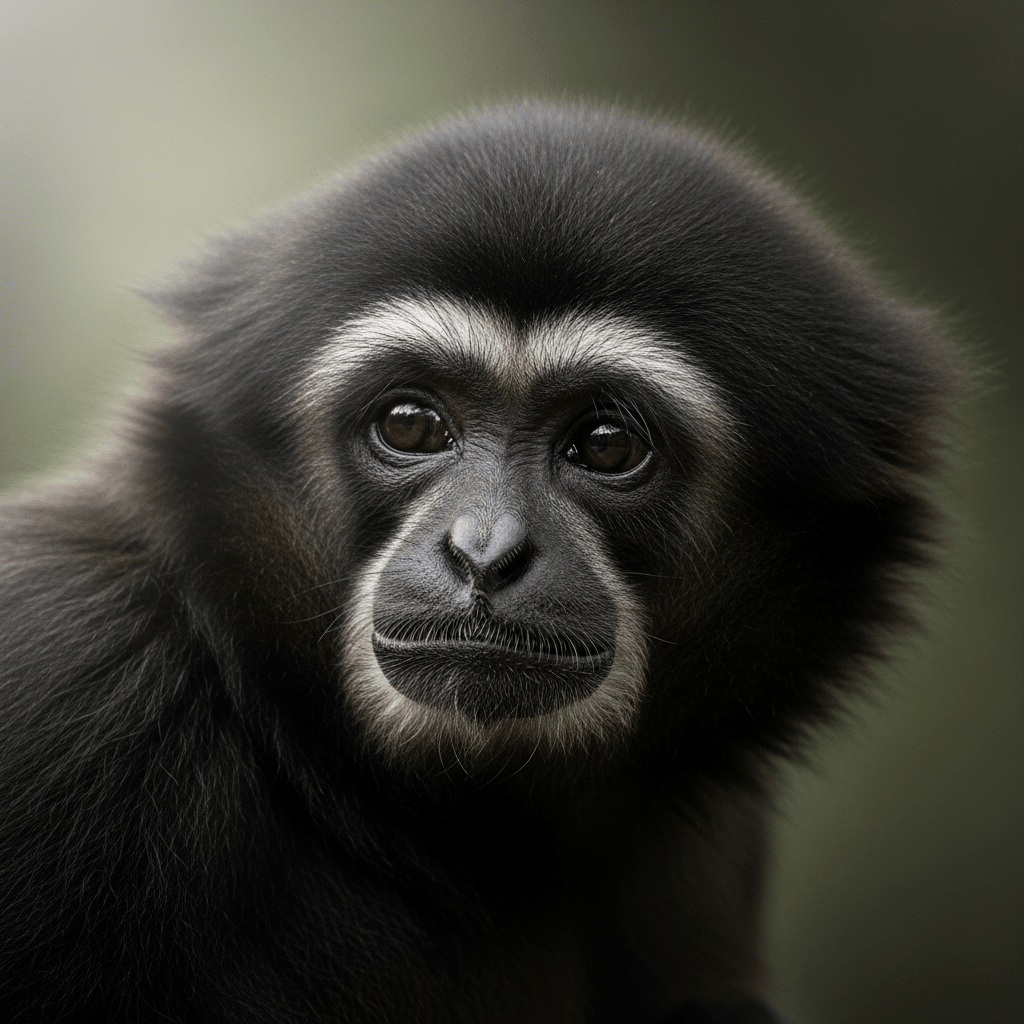
Kloss's Gibbon
Kloss's gibbon (Hylobates klossii) is a small, arboreal ape endemic to Indonesia's Mentawai Islands, known for its uniformly black fur and melodious calls.
Kloss's gibbon (Hylobates klossii) is a small, arboreal ape endemic to Indonesia's Mentawai Islands, known for its uniformly black fur and melodious calls.
First described in 1929 by Frederick Nutter Chasen and Cecil Boden Kloss, Kloss's gibbon was identified from specimens on Siberut Island in the Mentawai archipelago. Its lineage reflects long-term isolation, setting it apart genetically and morphologically from mainland Southeast Asian gibbons.
Belonging to the family Hylobatidae, Kloss's gibbon is classified within the genus Hylobates, a group of lesser apes native to Southeast Asia. It is recognized as a distinct species without any subspecies or hybrid forms.
Kloss's gibbon is notable for its small size, measuring 44–63 cm in length and weighing 5–6 kg. Both males and females display a striking uniform black coat with no sexual dimorphism in coloration. Its hairless dark face and long arms are well adapted for agile brachiation through the forest canopy.
This diurnal and territorial ape lives in small, monogamous family groups. It is strictly arboreal and communicates through complex, melodious vocalizations that serve to defend territory and strengthen pair bonds. Its behavior reflects a delicate balance with its forest environment.
Bring this kind into your world illustrated posters, mugs, and shirts.

Archival print, museum-grade paper
Buy Poster
Stoneware mug, dishwasher safe
Buy Mug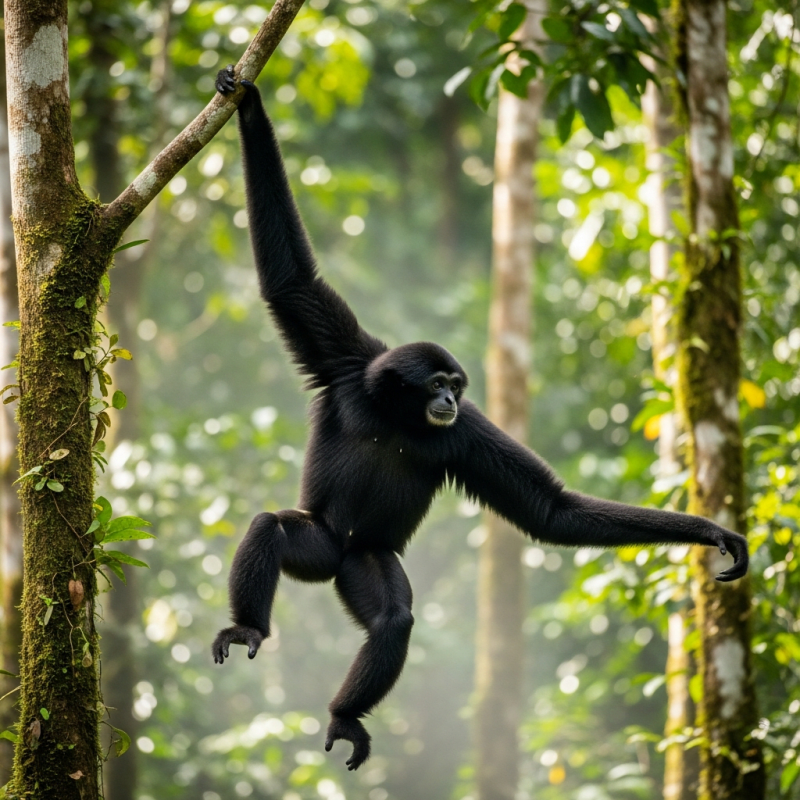
Soft cotton tee, unisex sizes
Buy ShirtAmong the Mentawai people, Kloss's gibbon holds cultural importance, protected by traditional taboos that discourage hunting. Although not widely known outside its range, it features in local ecotourism and conservation education, symbolizing the unique biodiversity of the Mentawai Islands.
Kloss's gibbon inhabits primary and secondary tropical rainforests across the Mentawai Islands, Indonesia, ranging from sea level up to 400 meters elevation. Its distribution is highly restricted, confined to this isolated archipelago west of Sumatra.


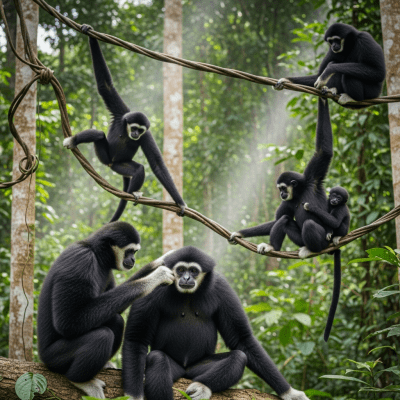
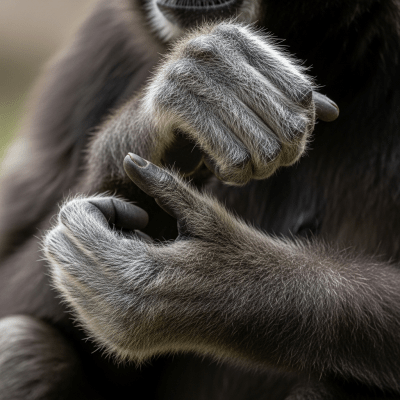

This species lives in small, monogamous family groups that are territorial and diurnal. Such social units rely on vocal communication to maintain boundaries and reinforce pair bonds, reflecting a stable but delicate social organization.
Kloss's gibbon primarily feeds on ripe fruits, which form the bulk of its diet. It also supplements its nutrition with leaves, flowers, and insects, foraging throughout the forest canopy during daylight hours.
Classified as Endangered, Kloss's gibbon faces major threats from habitat loss and fragmentation due to logging and land conversion. Although local taboos reduce hunting, increased human pressures have intensified risks. It is legally protected under Indonesian law and listed on CITES Appendix I, banning international trade.
Genetically distinct due to prolonged isolation on the Mentawai Islands, Kloss's gibbon shows no evidence of hybridization with other gibbon species. Its evolutionary lineage within the genus Hylobates highlights the unique biodiversity fostered by island isolation.