
Bonobo
The bonobo (Pan paniscus) is a distinct species of great ape known for its slender build, matriarchal societies, and unique social behaviors that emphasize cooperation and peaceful conflict resolution.
The bonobo (Pan paniscus) is a distinct species of great ape known for its slender build, matriarchal societies, and unique social behaviors that emphasize cooperation and peaceful conflict resolution.
First described in 1929 by Ernst Schwarz, the bonobo was identified as a separate species from the common chimpanzee based on specimens collected in Sankuru, Democratic Republic of the Congo. Its evolutionary lineage diverged from its closest relative approximately one to two million years ago.
Bonobos belong to the family Hominidae within the superfamily Hominoidea, which encompasses all great apes. Within this family, they are classified in the subfamily Homininae, tribe Panini, genus Pan, and species Pan paniscus. They are the sister species to the common chimpanzee (Pan troglodytes).
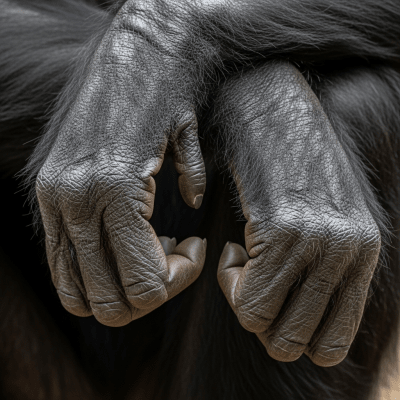
Bonobos are medium-sized apes with a more gracile and slender form compared to chimpanzees. Adult males weigh between 34 and 39 kilograms, females 27 to 34 kilograms, and stand about 70 to 83 centimeters tall. They have black faces with distinctive pink lips and hair parted down the middle of the head. Their features include longer legs, smaller heads, and less pronounced brow ridges, with subtle sexual dimorphism favoring slightly larger males.
Bonobos exhibit highly social and tolerant behavior, characterized by a matriarchal social structure where females form strong bonds and lead groups. Their social interactions are notable for frequent sexual behaviors that serve to reduce tension and resolve conflicts peacefully. They live in fission-fusion groups ranging from 20 to 100 individuals, combining arboreal and terrestrial locomotion, including knuckle-walking and occasional bipedalism.
Bring this kind into your world illustrated posters, mugs, and shirts.

Archival print, museum-grade paper
Buy Poster
Stoneware mug, dishwasher safe
Buy Mug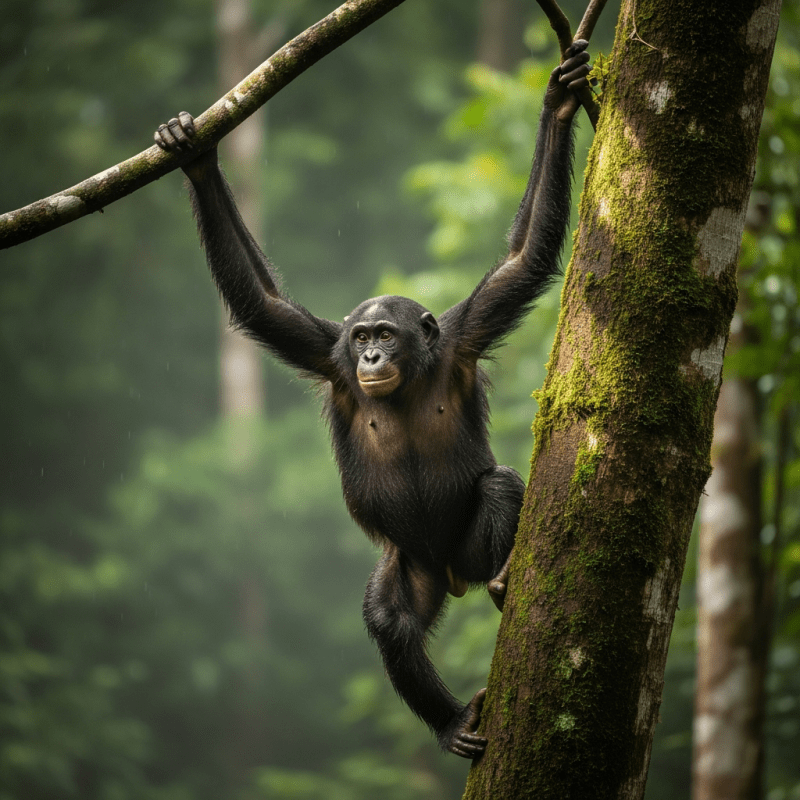
Soft cotton tee, unisex sizes
Buy ShirtWhile bonobos have no direct commercial or culinary use, they hold significant cultural and scientific value. They are subjects of extensive research into primate cognition, social behavior, and human evolution. Locally, they are known by various names such as Bilia and Bolobo in Lingala, reflecting their importance in regional languages and traditions within the Democratic Republic of the Congo.
Bonobos inhabit dense, humid lowland rainforests, swamp forests, and seasonally flooded forests below 400 meters elevation. Their range is restricted to the Democratic Republic of the Congo, specifically south of the Congo River, which serves as a natural geographic boundary separating them from chimpanzees.


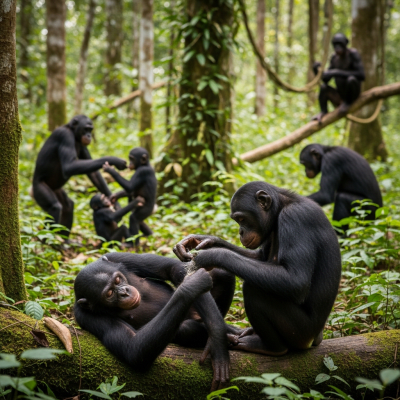

Bonobo societies are highly matriarchal, with females forming strong alliances that influence group dynamics. Groups typically range from 20 to 100 individuals and exhibit fission-fusion dynamics, where subgroups frequently split and merge. Social interactions are marked by tolerance and cooperation, with sexual behaviors playing a key role in maintaining peace and social bonds.
Bonobos are omnivores with a diet primarily composed of fruit, which makes up 57 to 63 percent of their intake. They also consume leaves, seeds, flowers, invertebrates, and occasionally small vertebrates. Their feeding habits reflect the rich biodiversity of their rainforest habitat.
Bonobos are listed as Endangered, facing threats from habitat destruction due to deforestation for agriculture and logging, illegal bushmeat hunting, and the impacts of ongoing civil unrest in their native region. Conservation efforts focus on habitat protection, anti-poaching measures, and supporting local communities to reduce human-wildlife conflict.
Genetically, bonobos are closely related to common chimpanzees, sharing a recent common ancestor about one to two million years ago. They maintain reproductive isolation primarily through geographic separation by the Congo River, with no confirmed natural hybridization events. Their genetic makeup contributes valuable insights into primate evolution and human ancestry.