
Agile Gibbon
The agile gibbon (Hylobates agilis) is a small, arboreal lesser ape known for its remarkable agility and melodious calls, inhabiting the rainforests of Sumatra and the Malay Peninsula.
The agile gibbon (Hylobates agilis) is a small, arboreal lesser ape known for its remarkable agility and melodious calls, inhabiting the rainforests of Sumatra and the Malay Peninsula.
First described by F. Cuvier in 1821 from specimens collected in Sumatra, the agile gibbon has long been recognized as a distinct species within the rich biodiversity of Southeast Asian tropical forests. Its discovery in the early 19th century marked an important addition to primate taxonomy during a period of expanding natural history exploration.
The agile gibbon belongs to the superfamily Hominoidea, family Hylobatidae, and genus Hylobates. As a member of the lesser apes, it is closely related to other gibbons, distinguished from the great apes by its smaller size and specialized arboreal adaptations. Taxonomic debates continue regarding its delimitation from Hylobates albibarbis, reflecting ongoing refinement in gibbon classification.
Agile gibbons have slender bodies measuring 44 to 63 centimeters in length and weigh between 4 and 6 kilograms. Their fur ranges from black to brownish or buff, often featuring a distinctive white brow and facial ring. Adapted for life in the canopy, they possess long arms, reduced tails, hook-shaped hands, and elongated fingers that enable swift brachiation through the forest.
Highly territorial and diurnal, agile gibbons live in small, monogamous family groups. They are renowned for their acrobatic brachiation, swinging hand-over-hand through the treetops with ease. Their vocalizations serve both to mark territory and strengthen pair bonds. These behaviors contribute to their ecological role in seed dispersal and maintaining forest dynamics.
Bring this kind into your world illustrated posters, mugs, and shirts.

Archival print, museum-grade paper
Buy Poster
Stoneware mug, dishwasher safe
Buy Mug
Soft cotton tee, unisex sizes
Buy ShirtIn local cultures, the agile gibbon is often featured in folklore and regarded as a symbol of the forest’s vitality. Its melodious calls and graceful movements have inspired traditional stories and continue to serve as a flagship species for conservation efforts in the region.
Agile gibbons are native to the dense rainforests of Sumatra and the Malay Peninsula, where they occupy the upper canopy layers. Their arboreal lifestyle depends on continuous forest cover, making them highly sensitive to habitat fragmentation and deforestation in these tropical regions.



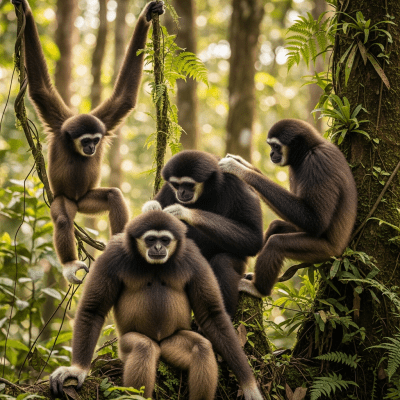

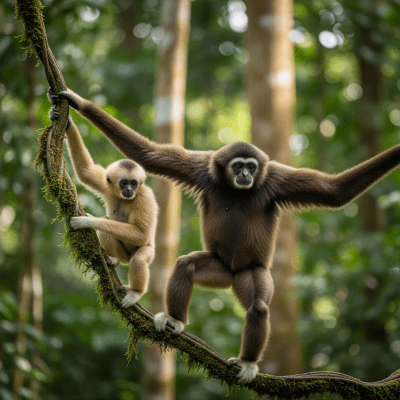
These gibbons live in small, monogamous family groups that are highly territorial. Each group typically consists of a mated pair and their offspring, maintaining and defending their territory through vocal duets and displays. Their social bonds are strong, with parental care focused on nurturing the young until independence.
While specific dietary details are limited, agile gibbons primarily feed on fruits, supplemented by leaves, flowers, and insects. Their feeding habits contribute to seed dispersal, playing a vital role in maintaining forest ecosystem health.
⚠️ Conservation Status: The agile gibbon is listed as Endangered, facing a declining population trend. Major threats include habitat fragmentation from logging and agricultural expansion, illegal pet trade, and hunting for bushmeat. Strict legal protections under CITES Appendix I prohibit international trade, but enforcement challenges remain in some areas.
As a member of the lesser apes, the agile gibbon shares a close evolutionary relationship with other Hylobates species. Genetic studies highlight ongoing debates about species boundaries, particularly with Hylobates albibarbis. Their adaptations for brachiation and arboreal life reflect a specialized evolutionary path distinct from great apes.